
15 easy science experiments for kids at home, with kitchen items
You don’t need a lab. Salt, water, a lemon, some baking soda and a curious child are enough for an afternoon of real science.
Here are 15 experiments that work with things already in an Indian kitchen, each with what you need, what to do, and the science in one or two lines. An adult should be around for every one.
On this page
1. Before you start
- An adult supervises every experiment, especially anything with heat.
- Nothing goes in the mouth unless the experiment is about food.
- Do messy ones on a tray or outdoors.
2. Water experiments
1. Walking water
Need: 3 glasses, tissue paper, food colour. Fill the outer glasses with coloured water, leave the middle one empty, and bridge them with folded tissue. In an hour the middle glass fills. Science: water climbs the tiny gaps in paper — capillary action, the same way plants drink.
2. Floating egg
An egg sinks in plain water. Stir in 6–8 spoons of salt and it floats. Science: salt water is denser, so it pushes up harder.
3. Pepper and soap
Sprinkle pepper on a plate of water and touch it with a soapy finger — the pepper rushes away. Science: soap breaks the water’s surface tension.
4. Homemade rainbow
Place a glass of water on a sunny windowsill with white paper below. Science: water bends sunlight and splits it into colours.
5. Sink or float
Guess first, then test: coin, leaf, spoon, potato, plastic lid, lemon. Science: it depends on density and shape, not just weight.
3. Fizz and bubble experiments
6. Baking soda volcano
Put 2 spoons of baking soda in a bottle inside a mound of clay or sand, add a drop of food colour and pour in vinegar. Science: an acid (vinegar) and a base (baking soda) react and release carbon dioxide gas.
7. Lava lamp
Fill a bottle one-quarter with water, top up with cooking oil, add food colour, then drop in a pinch of Eno or a fizzy tablet. Science: oil and water don’t mix; gas bubbles carry coloured water up, then it sinks again.
8. Balloon blow-up
Baking soda inside a balloon, vinegar in a bottle; stretch the balloon over the mouth and tip the soda in. The gas inflates the balloon.
9. Dancing raisins
Drop raisins into a glass of soda water. They rise and sink. Science: gas bubbles stick to the raisins and lift them, then pop at the top.
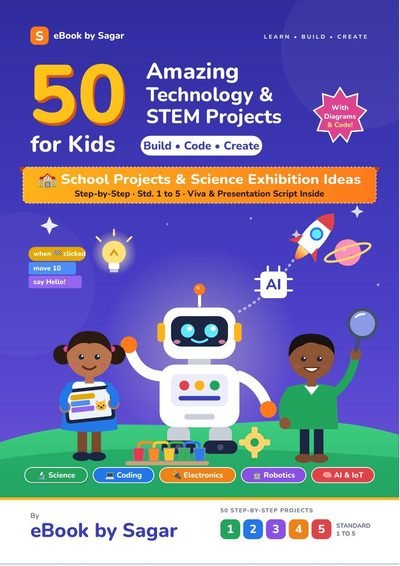 Turning one of these into a school project? Our STEM book has 50 projects with step-by-step pictures, costs and viva questions. See the 50 Amazing Technology & STEM Projects for Kids →
4. More quick experiments
10. Invisible ink
Write with lemon juice and a cotton bud; let it dry. An adult warms the paper with an iron or near a bulb and the writing turns brown. Science: heat makes the lemon juice oxidise and darken faster than paper.
11. Static balloon
Rub a balloon on dry hair, then hold it over tiny paper bits. They jump up. Science: static electricity.
12. Grow a bean
Put a rajma or moong seed on wet cotton in a clear glass. Watch roots and a shoot in 3–5 days. Keep a drawing diary.
13. Red cabbage indicator
Boil chopped red cabbage (adult), cool and strain the purple water. Add lemon juice (turns pink) or baking soda (turns blue-green). Science: the colour shows acid or base.
14. Paper bridge
A flat sheet between two books can’t hold a coin. Fold it like a fan and it holds many. Science: shape makes materials stronger.
15. Ice and salt fishing
Lay a thread on an ice cube, sprinkle salt, wait 30 seconds and lift — the ice comes up on the thread. Science: salt melts the ice a little, then it refreezes around the thread.
5. Turn it into a real experiment
Ask the child to follow the five steps scientists use. It turns a fun trick into proper thinking — and a strong school project.
| Step | Example (floating egg) |
|---|---|
| Question | Can an egg float? |
| Guess (hypothesis) | “It will float if I add salt.” |
| Test | Add salt one spoon at a time |
| Observe | It floated after 7 spoons |
| Conclude | Salt water is denser and holds the egg up |
For exhibition-level ideas, see science exhibition projects for kids.
Questions parents ask
What is the easiest science experiment for kids at home?
Walking water, the floating egg and the baking soda volcano. They need only kitchen items and work every time.
Which science experiments can a 5-year-old do?
Sink or float, walking water, dancing raisins, growing a bean and the static balloon, all with an adult nearby.
How do I make a volcano at home?
Put baking soda in a small bottle, build sand or clay around it, add a drop of food colour and pour in vinegar.
Which experiment is good for a Class 3 school project?
The red cabbage acid-base indicator or the floating egg, written up with the five steps: question, guess, test, observe, conclude.
50 Amazing Technology & STEM Projects for Kids
50 school projects · Class 1 to 5
- Step-by-step pictures and a materials list with costs
- Science, Scratch, Arduino, robotics and AI ideas
- Viva questions and a presentation script
Print as many times as you like · Buy any 2 packs together and get 10% off