
15 mental maths tricks for kids, with examples (Class 1–5)
Some children seem to “just know” that 8 + 7 is 15 or that 25 × 12 is 300. They are not born with it — they use small tricks, usually without knowing it. The good news: every one of these tricks can be taught, and most take less than ten minutes to learn.
Here are the 15 we have found most useful for Indian school children in Class 1 to 5, grouped by class, each with a worked example you can try at the dinner table tonight.
On this page
1. Why mental maths matters
Mental maths is not about doing sums without a pencil for the sake of it. A child who can quickly see that 48 + 35 is “50 + 35, minus 2” understands how numbers fit together. That number sense makes written sums, fractions, and later algebra far easier — and it saves time in every exam. That is why many Class 1–5 maths textbooks now include short mental maths exercises.
2. Tricks for Class 1–2
Trick 1: Count on from the bigger number
For 3 + 9, don’t count 3 and then 9. Start at 9 and count on three: 10, 11, 12. Always start with the bigger number.
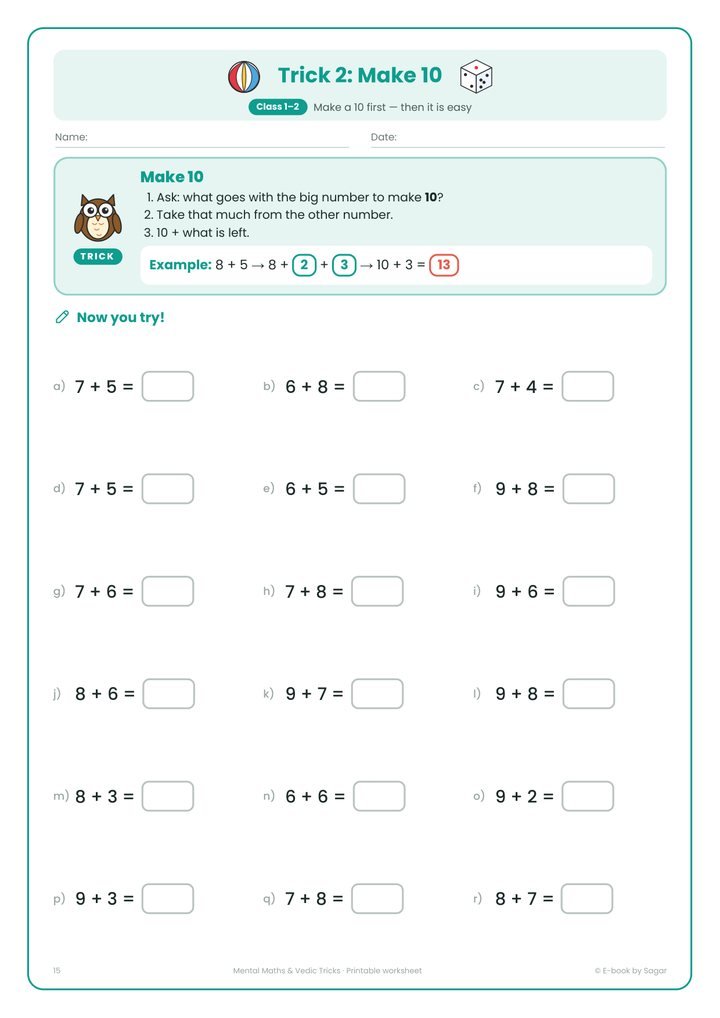
Trick 2: Make 10
For 8 + 5, ask “what goes with 8 to make 10?” It is 2. Take 2 from the 5: 8 + 2 + 3 = 10 + 3 = 13. This is the single most useful addition trick — it works for every sum that crosses 10.
Trick 3: Doubles and near doubles
Learn the doubles (6 + 6 = 12, 7 + 7 = 14…). Then 7 + 8 is just double 7 plus 1 = 15.
Trick 4: Number bonds to 10
Know the pairs that make 10 by heart: 1+9, 2+8, 3+7, 4+6, 5+5. They are the building blocks of tricks 2, 5 and 9.
3. Tricks for Class 3–4
Trick 5: Add 9 = add 10, take 1
46 + 9 → 46 + 10 = 56, then take 1 → 55. The same works for 19 (add 20, take 1) and 99 (add 100, take 1).
Trick 6: Subtract 9 = take 10, give 1 back
63 − 9 → 63 − 10 = 53, then add 1 → 54.
Trick 7: Break apart (tens first)
46 + 27 → tens: 40 + 20 = 60; ones: 6 + 7 = 13; together 73. Adding from the left is how most adults do sums in their head.
Trick 8: Round and adjust
48 + 35 → 50 + 35 = 85, but we added 2 extra, so 83. Use it whenever a number ends in 8 or 9.
Trick 9: Count up to subtract
For 62 − 57, the numbers are close, so count up from 57: +3 to 60, +2 to 62. Answer: 5. Shopkeepers give change this way.
Trick 10: Times 5 = times 10, then half
48 × 5 → 480, half of 480 = 240.
Trick 11: Double, double
×4 is double twice: 13 × 4 → 26 → 52. ×8 is double three times.
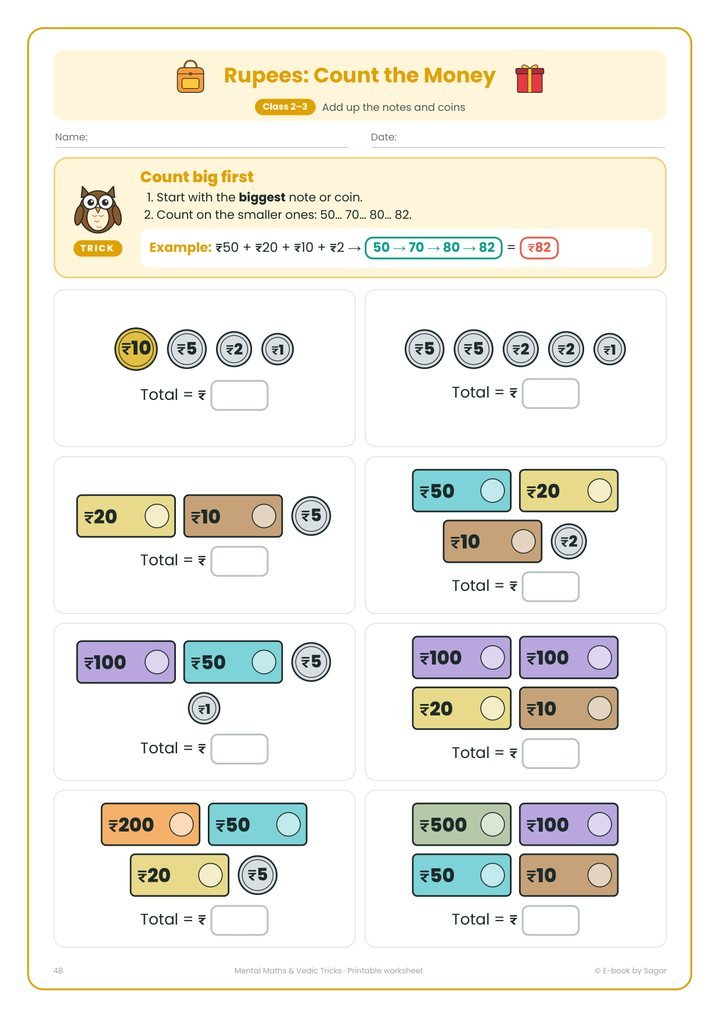
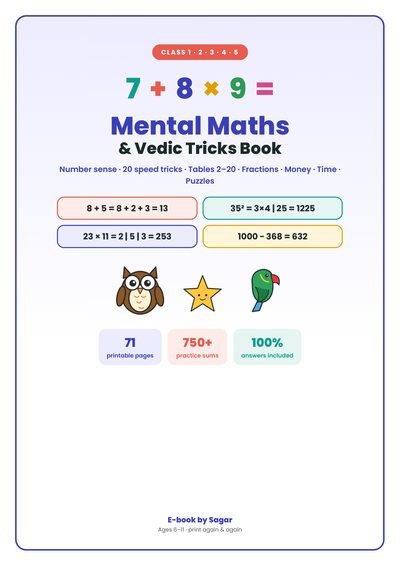 Want every one of these tricks on its own page, with a worked example, 16–18 practice sums and answers? See the Mental Maths & Vedic Tricks Book (Class 1-5) →
4. Tricks for Class 4–5
Trick 12: Times 11 for two-digit numbers
Split the digits and put their sum in the middle: 23 × 11 → 2 _ 3 → 2 (2+3) 3 = 253. If the middle sum is 10 or more, carry 1: 75 × 11 → 7 (12) 5 → 825.
Trick 13: Times 25 = times 100, then divide by 4
16 × 25 → 1600 ÷ 4 = 400. Children love this one because it turns a scary sum into an easy one.
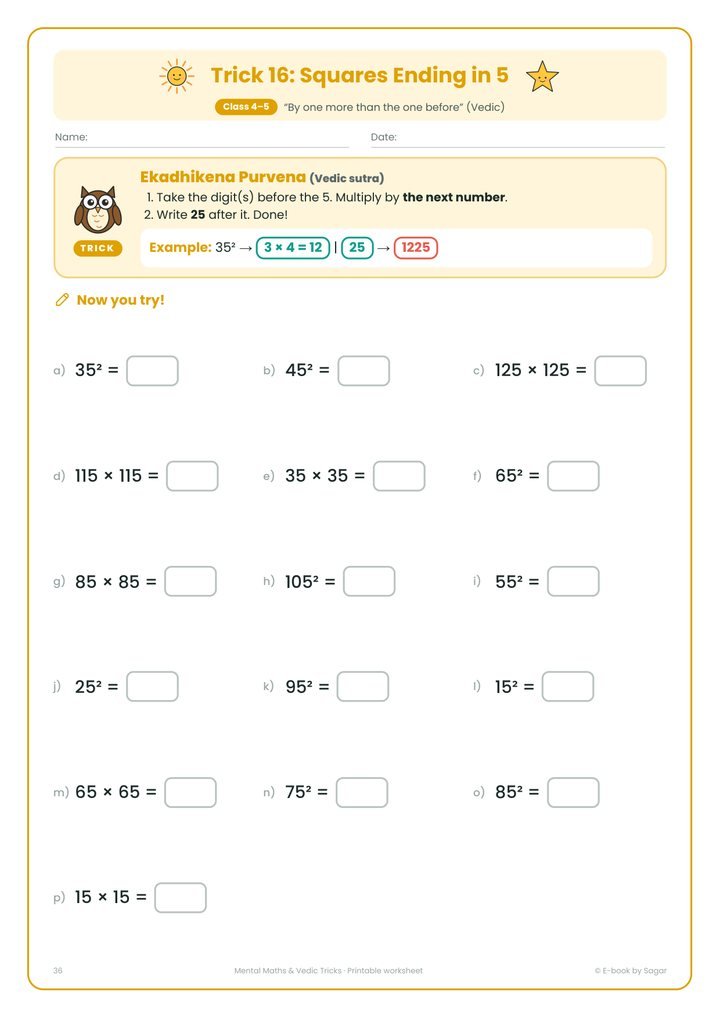
Trick 14: Squares of numbers ending in 5
35²: take the 3, multiply by the next number (4) = 12, then write 25 → 1225. This comes from Vedic maths — see our Vedic maths guide for more.
Trick 15: Divide using tables
For 56 ÷ 8 ask “8 times what is 56?” Division is just a times table backwards, so strong tables make division easy.
5. A 10-minute daily plan
| Minutes | What to do |
|---|---|
| 0–2 | Warm up: say one table aloud, or number bonds to 10 |
| 2–5 | Learn or revise one trick with the worked example |
| 5–9 | Do 10–15 practice sums using that trick |
| 9–10 | Check answers together and ask “how did you do that one?” |
Once a week, swap the practice for a timed speed drill and write the score down. Beating last week’s score is very motivating.
6. Mistakes to avoid
- Teaching five tricks at once. One trick a day, practised well, sticks. Five tricks in one sitting get mixed up.
- Racing before they are right. Accuracy first, speed second. Fast and wrong does not help.
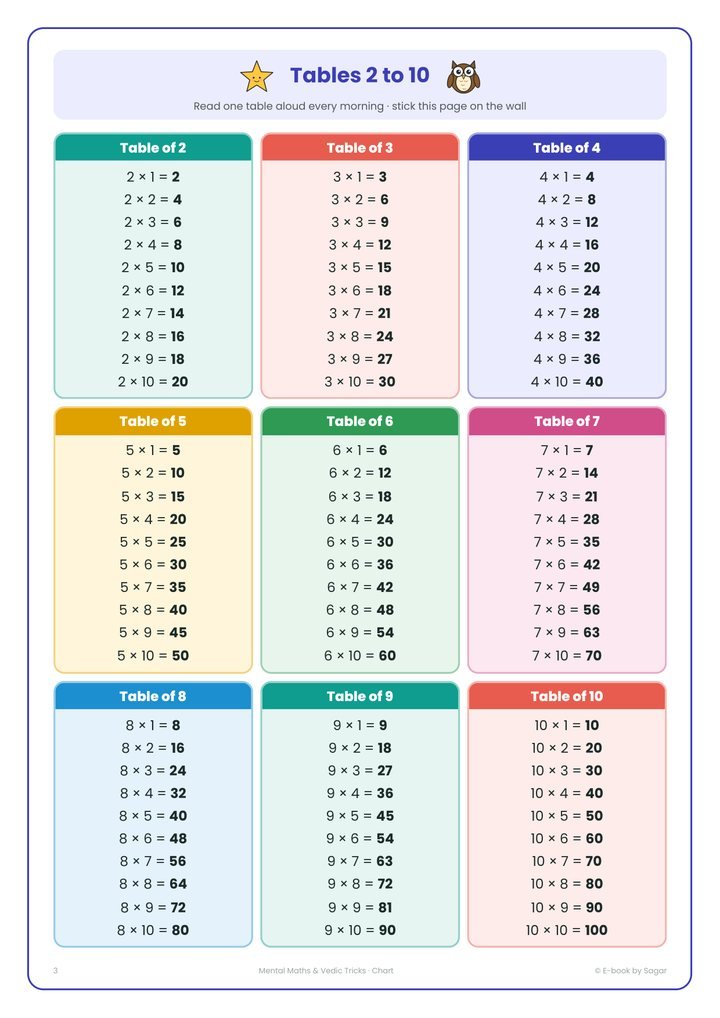
- Skipping tables. Tricks make tables easier but don’t replace them. Most Class 3–5 tricks need tables up to 10.
- Fighting the school method. Mental tricks sit alongside the written column method. If the teacher wants working shown, show it.
Questions parents ask
At what age should children start mental maths?
Simple counting on and number bonds can start at 5–6 (Class 1). Multiplication tricks suit ages 8–11 (Class 3–5), once the child knows tables up to 10.
How can my child do maths faster?
Learn one trick at a time, practise it for a few days, and do one short timed drill a week. Speed comes from knowing number bonds and tables really well.
Are mental maths tricks allowed in school exams?
Yes — they are just faster ways to get the same answer. If a question asks for working, write the steps the teacher expects.
Is mental maths the same as Vedic maths?
Not exactly. Mental maths is any way of calculating in your head. Vedic maths is one set of tricks, popularised by Bharati Krishna Tirthaji, that many children find fun.
Mental Maths & Vedic Tricks Book (Class 1–5)
71 printable pages · Class 1 to 5
- 20 speed tricks incl. Vedic maths, one per page
- Tables 2–20, 6 timed drills, fractions, money, time
- 760+ sums, puzzles and a full answer key
Print as many times as you like · Buy any 2 packs together and get 10% off