
How to teach numbers and counting to kids: a step-by-step guide
Many three year olds can rattle off "one, two, three, four, five, six, seven, eight, nine, ten" in a single breath. Ask the same child to give you four biscuits, though, and you may get two, or six, or the whole packet. Reciting numbers and understanding numbers are two very different things.
Real number sense — knowing that "four" means a quantity, that it is one more than three, and that it looks like the numeral 4 — is the foundation of every bit of maths that follows. This guide shows you how to teach numbers and counting to kids aged two to six, in the order children actually learn them, with everyday activities, a counting game to play together, and the mistakes to avoid.
On this page
1. The 6 building blocks of number sense
Counting looks like one skill, but it is really several small skills that children pick up one after another. Teaching them in this order makes everything easier:
- Rote countingSaying number words in order: "one, two, three". Like a song, without meaning yet.
- One-to-one countingTouching each object once while saying one number. No skipping, no double-counting.
- Cardinality: "how many?"Understanding that the last number said tells you how many there are altogether.
- SubitisingSeeing small amounts, up to about 5, instantly without counting, like the dots on a dice.
- Numeral recognitionLinking the symbol 4 to the word "four" and to four things.
- Comparing and changingMore, fewer, one more, one less, and simple adding and taking away.
The building blocks of number sense, in the order most children learn them
Most early number trouble comes from jumping to step 5 — writing numerals — before steps 2 and 3 are secure. A child who can write 7 but cannot count out seven spoons has learnt a shape, not a number.
2. What to expect at each age
| Age | Typical number skills |
|---|---|
| 2–3 years | Says some number words, often out of order. Understands "one" and "more". Counts 2 or 3 objects with help. |
| 3–4 years (nursery) | Counts to 10 out loud. Counts up to 5 objects correctly. Recognises some numerals. Knows "more" and "less". |
| 4–5 years (LKG) | Counts 10 or more objects. Recognises numerals 1–10, starts writing them. Understands "one more" and "one less". |
| 5–6 years (UKG) | Counts to 20 and beyond, recognises and writes numerals to 20, simple adding and taking away with objects, before and after numbers. |
These are broad ranges. Children who get lots of everyday counting at home are often ahead; children who have had less exposure catch up quickly once they start. Our guide to what a child should know before LKG covers number skills along with everything else.
3. How to teach numbers to kids: step by step
Step 1: Count everything, out loud
Count stairs as you climb, rotis as you put them on the plate, buttons as you do up a shirt, cars at a signal. Children learn number words the same way they learn every other word: by hearing them in real life, many times a day.
Step 2: Teach touch-and-count
Line up a few objects in a row. Take your child's finger and touch each one as you say the number together. Moving each object to a new pile as you count it works even better, because it is impossible to count the same thing twice.
Step 3: Ask "how many?"
After counting, always ask "So how many spoons are there?" At first your child may count again. The moment they answer "four" without recounting, they have understood cardinality — a big milestone.
Step 4: Play with small amounts
Roll a dice, show fingers, or flash dot cards for a second and ask "How many?" Recognising 1 to 5 at a glance (subitising) builds a sense of how big numbers are, and later makes adding much faster.
Step 5: Connect numerals to quantities
Now introduce the written numbers. Match a numeral card to a group of objects, find house numbers on a walk, or spot numbers on a calendar. Always connect the symbol back to a real amount.
Step 6: Compare, add and take away
"You have three grapes and I have five. Who has more?" "If I eat one, how many are left?" Using real objects for these questions, long before written sums, is how children understand what adding and subtracting mean.
How many can you see?
Count the pictures together, touching each one on the screen, then tap the right number. Start with "up to 5" for younger children.
4. Teaching children to write numbers
Writing numerals needs pencil control, so it usually begins around four, once a child can draw lines and circles. If your child is not there yet, start with the hand-strength play in our fine motor activities guide.
A good progression for writing numbers:
- Trace in sand, rice or the air with a finger, saying the number's path out loud.
- Trace large dotted numbers on worksheets, always starting at the top.
- Copy a number next to a model.
- Write from memory when you say a number, then draw that many dots next to it.
Little rhymes help children remember the strokes. For example: "Straight line down and then you're done, that's the way to make a 1." "Around and back on the railroad track, 2, 2, 2." Make up your own; silly ones stick best.
5. Numbers 11 to 20 (and why they are tricky)
After ten, English number names stop making sense. "Eleven" and "twelve" do not sound like "ten and one" or "ten and two", and "thirteen" to "nineteen" say the ones before the ten, even though we write the ten first. No wonder children say "eleventeen"!
A few things help:
- Use ten-frames or bundles. Show 14 as one bundle of ten sticks plus four loose sticks. Children see that teen numbers are "ten and some more".
- Say it the long way first. "Ten and three is thirteen." The pattern becomes clear.
- Practise counting on. Start at 10 instead of 1: "ten, eleven, twelve…".
- Use a number line. A strip of paper from 1 to 20 on the wall helps children see where each number sits.
6. 15 number activities for kids at home
- Stair counting: Count every step up and down.
- Table setting: "We need four plates. Can you count them out?"
- Snack counting: Count out five grapes, eat one, how many now?
- Number hunt: Find numbers on clocks, phones, buses and house gates.
- Dice games: Simple board games like Snakes and Ladders practise counting and subitising.
- Clap and jump: "Jump three times. Clap seven times."
- Peg plates: Write a number on each paper plate; your child clips on that many clothes pegs.
- Toy shop: Price toys at 1 to 5 rupees and pay with real coins.
- Number line hop: Chalk 1 to 10 on the floor and hop along.
- Finger counting: "Show me three fingers. Now one more."
- Sorting and counting: Sort toys by colour and count each group. Which has more?
- Counting songs: "Five little monkeys", "One two, buckle my shoe", and counting rhymes in your home language.
- Rangoli dots: Make a pattern of dots and count them together.
- Dot-to-dot pictures: Join numbered dots to reveal a picture.
- Count in other languages: Hindi, Marathi, Tamil, Bengali — counting in a second language at home strengthens number sense too.
Festivals are perfect for counting practice. Our list of Diwali activities for kids includes diya counting and sweet sorting.
7. Common mistakes to avoid
- Mistaking reciting for counting. Counting to 20 out loud is lovely, but always check whether your child can count out a set of objects too.
- Starting with written sums. 2 + 3 on paper means nothing until a child has combined two and three real things many times.
- Only counting from 1. Count backwards, count on from different numbers, and count in twos later on.
- Too many worksheets, too early. Worksheets are great for practice once the idea is understood with objects. They cannot replace the objects.
- Showing worry about maths. Children pick up "I was bad at maths" very easily. Make numbers playful and everyday.
8. Questions parents ask
At what age should a child count to 10?
Many children can say the numbers to 10 by around three to four, and count ten objects correctly by four to five. Counting out loud usually comes before understanding how many.
How do I teach my toddler to count?
Count real things every day, such as stairs, rotis and toys. Touch or move each object as you count, and then ask how many there are. Start with groups of two or three.
Should I teach number writing or counting first?
Counting first. A child should be able to count out a small group of objects and recognise numerals before writing them. Writing usually begins around age four, once pencil control is ready.
Why does my child write numbers backwards?
Writing numbers such as 3, 7 and 9 backwards is very common until around six or seven. Show the correct direction gently and keep practising; it usually corrects itself.
How can I teach numbers 11 to 20?
Show teen numbers as ten and some more, using bundles of ten sticks or a ten-frame. Say them the long way first, such as ten and three is thirteen, and practise counting on from ten.
Counting, tracing and early maths sheets
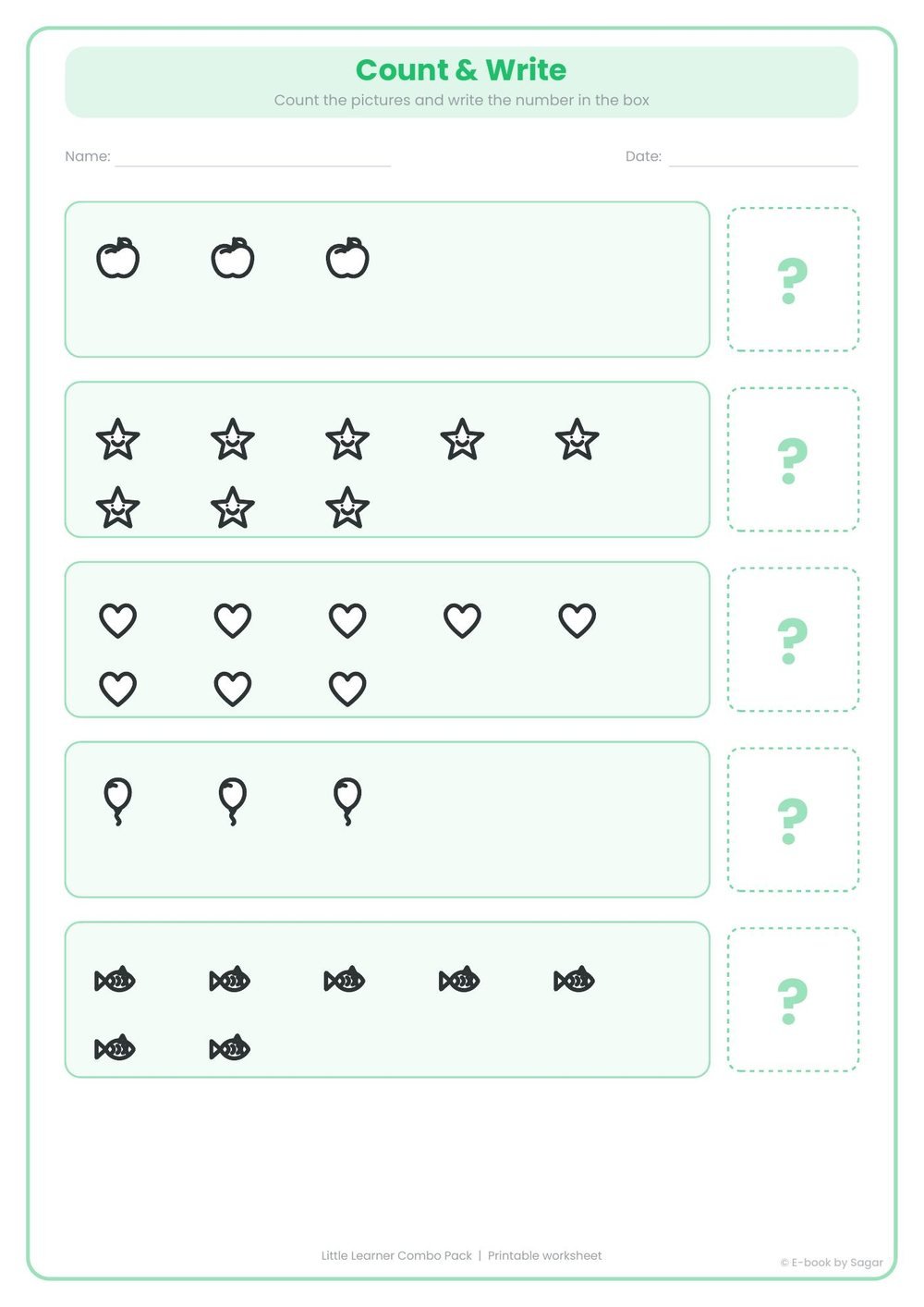
The Little Learner Combo Pack has 150 printable worksheets for ages 2 to 6, including number tracing, counting activities, early maths, flashcards and charts. Download once, print as often as you like.
See the worksheets pack — ₹49