
30 fine motor skills activities for toddlers and preschoolers
Before a child can write the letter A, they need to hold a pencil. Before they can hold a pencil, they need strong little fingers, a steady wrist and eyes that guide the hand. These are called fine motor skills, and they quietly decide how easily a child copes with nursery, LKG and UKG.
The good news is that fine motor skills grow through play, not worksheets alone. Tearing paper, rolling dough, picking up peas, pouring water — all the "messy" things toddlers love are exactly what their hands need. This guide explains what fine motor skills are, what to expect at each age, and 30 fine motor activities you can do at home with everyday things.
On this page
1. What are fine motor skills?
Fine motor skills are the small, precise movements of the fingers, hands and wrists, working together with the eyes. Picking up a raisin, turning a page, doing up a button, using a spoon and holding a crayon all use fine motor skills.
They are different from gross motor skills, which use the big muscles of the arms, legs and body: running, jumping, climbing and throwing. The two are connected. A child with a strong core and shoulders finds it easier to sit still and control their hand, so outdoor play matters for writing too.
Fine motor skills are built from a few smaller abilities:
- Hand strength: the muscles of the palm and fingers that let a child grip and squeeze.
- Pincer grasp: picking up small objects between the thumb and first finger.
- Hand–eye coordination: the eyes guiding where the hand goes.
- Bilateral coordination: both hands doing different jobs together, like holding paper with one hand while cutting with the other.
- Finger isolation: moving one finger on its own, such as pointing or pressing a button.
2. Why fine motor skills matter for school
In nursery and LKG, a large part of the day involves the hands: colouring, tracing, sticking, opening a tiffin box, zipping a bag, holding a pencil. A child with weaker hands tires quickly, avoids drawing, presses too hard or too lightly, and may feel they are "bad at writing" long before writing has really begun.
Teachers often notice that children who struggle with handwriting in UKG never had much chance to play with dough, scissors or small toys. The fix is rarely more writing. It is more hand play, followed by writing once the hand is ready.
3. How a child's grip develops
Children do not start with the "correct" pencil grip. They move through a series of grips as their hand matures. Knowing these stages helps you avoid forcing a grip your child is not ready for.
- Fist grip (1–2 years)The crayon is held in a fist, and the whole arm moves from the shoulder to scribble.
- Palm-down grip (2–3 years)Fingers wrap around the crayon with the palm facing the paper; movement comes from the elbow.
- Four or five finger grip (3–4 years)The crayon is held with several fingertips; the wrist starts to move.
- Tripod grip (4–6 years)Thumb, index and middle finger hold the pencil; small finger movements make the marks.
The four stages of pencil grip development, with typical ages
Ages vary from child to child. If your four year old still uses a palm-down grip, more hand-strength play usually helps more than correcting the grip again and again. Our step-by-step guide to teaching a child to hold a pencil explains how to move to the tripod grip.
4. Fine motor milestones by age
Use this checker to see the skills most children develop around each age. Choose an age, tick what your child can already do, and you will get a short note on what to focus on next.
What can my child do with their hands?
A guide based on widely used developmental milestones, not a medical test. Every child develops at their own pace.
5. Fine motor activities for toddlers (2–3 years)
At this age, the goal is strength and exploration. Keep activities short, messy and fun, and always supervise anything small enough to swallow.
- Tearing paper: Old newspapers or magazines torn into strips. Then stick the strips on a big sheet to make a collage.
- Playing with dough: Squeeze, poke, pinch and roll. Home-made atta dough with a little oil and salt works perfectly.
- Posting game: Cut a slot in a box lid and let your child post coins, bottle caps or cards through it.
- Stacking blocks or cups: Build a tower, knock it down, build it again.
- Peeling stickers: Peeling stickers off a sheet is excellent pincer grasp practice.
- Pouring: Pour water or dry rice from one cup to another, at the bathtub or on a tray.
- Big crayon scribbling: Large paper taped to the floor or wall, and chunky crayons.
- Opening and closing: Containers with screw lids, boxes, zips and velcro.
- Finger painting: Paint with fingers, then with just one finger to make dots.
- Picking up puffs or peas: At mealtimes, let them pick small foods one at a time.
6. Fine motor activities for preschoolers (3–5 years)
Now the focus shifts to control and coordination: using both hands together and making more precise movements.
- Threading beads: Start with big wooden beads on a shoelace, then smaller beads, then pasta on a string.
- Cutting with child-safe scissors: Begin with snipping strips, then cutting along thick straight lines, then curves.
- Clothes pegs: Clip pegs around the edge of a paper plate. Great for finger strength.
- Tongs and tweezers: Move pom-poms, cotton balls or rajma from one bowl to another with kitchen tongs.
- Lacing cards: Punch holes around a cardboard shape and lace a shoelace through.
- Sorting small objects: Sort buttons, beads or dals by colour into an ice-cube tray.
- Spray bottle watering: Squeezing a spray bottle to water plants builds the whole hand.
- Rolling roti: Give your child a small ball of dough and a mini belan.
- Sticker and glue art: Glue sticks, small paper shapes and stickers to make pictures.
- Puzzles: Wooden knob puzzles first, then simple jigsaws of 6 to 24 pieces.
7. Pre-writing activities (4–6 years)
These activities connect hand control to the shapes children will soon write. They work best once your child has had plenty of play from the lists above.
- Pre-writing strokes: Standing lines, sleeping lines, slanting lines, curves, circles and zig-zags. Every letter is built from these.
- Writing in a salt or rice tray: Draw shapes and letters with a finger, shake, and start again.
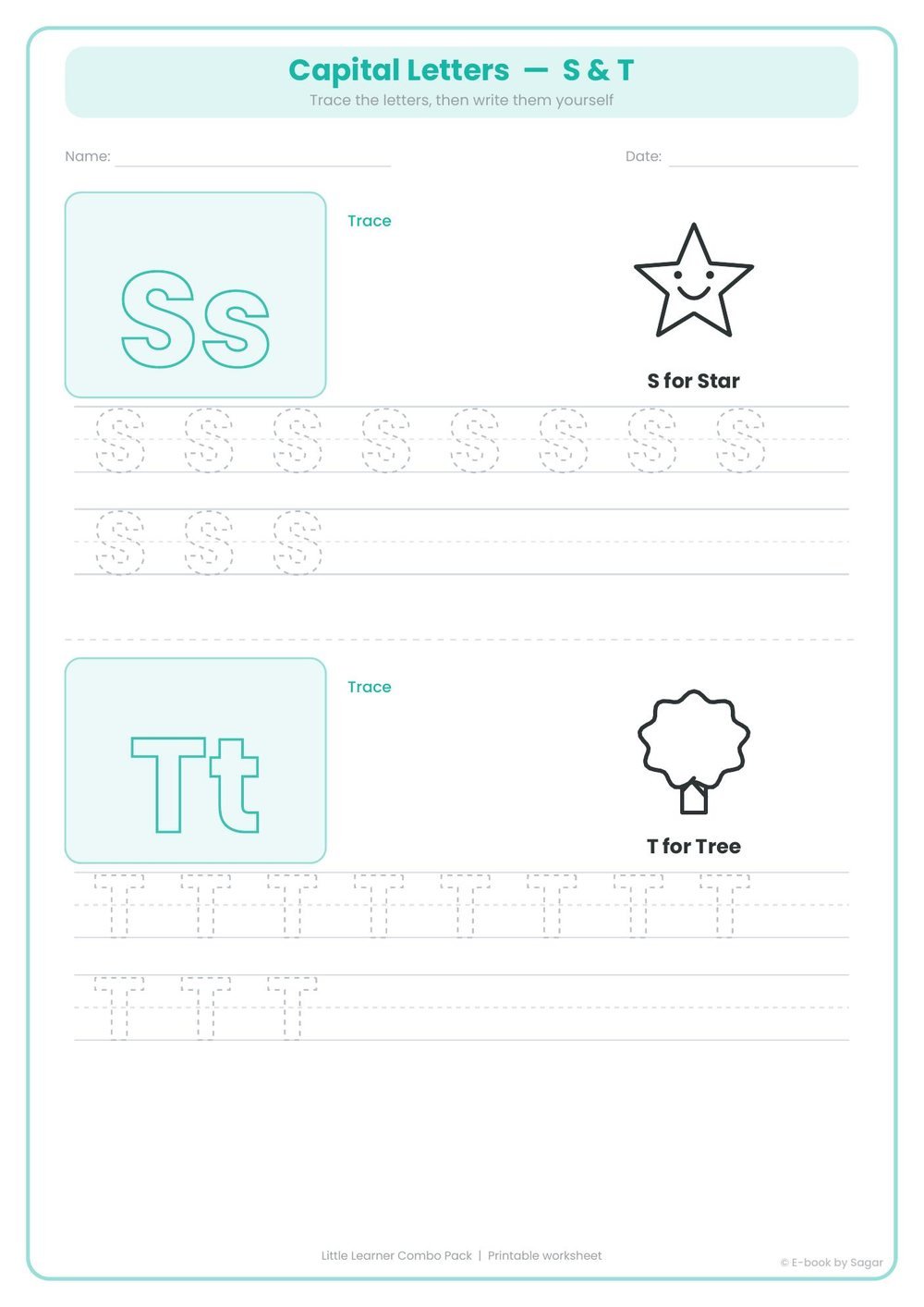
- Tracing worksheets: Dotted lines, shapes, then letters and numbers. Start large and get smaller.
- Mazes and dot-to-dot: Following a path with a pencil teaches control and planning.
- Colouring inside lines: Start with big, simple pictures with thick outlines.
- Drawing on a vertical surface: A board or paper taped to a wall strengthens the wrist in the right position.
- Folding paper: Fold napkins, simple paper boats or fans. Matching corners takes real precision.
- Buttoning practice: Practise on a big shirt worn by a teddy, then on their own clothes.
- Copying patterns: Copy a short pattern of shapes, then a few letters, from a model.
- Broken crayons: Short crayon pieces naturally encourage a fingertip grip instead of a fist.
8. Tips that make fine motor practice work
- Little and often. Ten minutes a day beats an hour on Sunday. Hand muscles grow with regular use, like any other muscle.
- Make it part of daily life. Let your child peel a banana, open the tiffin box, squeeze toothpaste and button their own shirt, even when it is slower.
- Follow the order. Strength and play first, then pre-writing strokes, then letters. Our guide on how to teach alphabets explains how this flows into writing.
- Sit well. Feet flat on the floor or a box, table at elbow height. A child who is balancing on a high chair has less control of their hand.
- Do not forget big movements. Climbing, crawling through tunnels, wheelbarrow walks and swinging build the shoulder and core stability that fine control depends on.
- Praise effort, not neatness. Wobbly lines are progress. Children who are corrected constantly start to avoid the crayon altogether.
When to ask for help
Children develop at different speeds, and a few months behind on one skill is rarely a concern. Speak to your paediatrician if your child strongly prefers one hand before the age of about eighteen months, finds most of the skills for their age very hard, seems to have weak or floppy hands, or avoids any task that uses the hands. An occupational therapist can assess fine motor skills and suggest exercises.
9. Questions parents ask
What are fine motor skills?
Fine motor skills are the small, precise movements of the fingers, hands and wrists, working with the eyes. Picking up small objects, using a spoon, buttoning and holding a crayon are all fine motor skills.
What are some examples of fine motor activities for toddlers?
Tearing paper, playing with dough, peeling stickers, stacking blocks, pouring rice or water between cups, posting coins into a box and finger painting are all simple fine motor activities for two and three year olds.
At what age should a child hold a pencil correctly?
Most children move to a tripod grip, with the thumb, index and middle finger, between about four and six years old. Before that, fist and palm-down grips are normal stages.
How can I improve my child's fine motor skills at home?
Do ten minutes of hand play every day: dough, pegs, tongs, threading, cutting and colouring. Let your child do everyday jobs like opening containers and buttoning, and include plenty of climbing and outdoor play for shoulder strength.
When should I worry about fine motor delay?
Talk to your paediatrician if your child finds most of the skills for their age very hard, strongly prefers one hand before about eighteen months, has weak or floppy hands, or avoids all hand tasks. An occupational therapist can help.
Pre-writing and tracing sheets, in the right order
The Little Learner Combo Pack has 150 printable worksheets for ages 2 to 6: pre-writing strokes, colouring, alphabet and number tracing, early maths and flashcards. A natural next step after the hand play above.
See the worksheets pack — ₹49