
How to improve your child’s handwriting: 10 tips that actually work
“Ma’am says the handwriting is not neat.” If that line from the school diary sounds familiar, you are in good company. Messy writing is one of the most common worries parents of Class 1–5 children have — and it is also one of the most fixable.
Handwriting is a physical skill, like cycling. It improves with the right setup and short, regular practice, not with scolding. Here are ten tips, in the order that makes the biggest difference.
On this page
1. Why handwriting gets messy
It is rarely laziness. The usual causes are:
- An awkward pencil grip that tires the hand quickly
- Weak finger and wrist muscles
- Writing too fast to finish homework
- Not knowing where each letter should sit on the lines
- Poor posture or a table that is too high
2. Ten tips that work
1. Fix the grip first
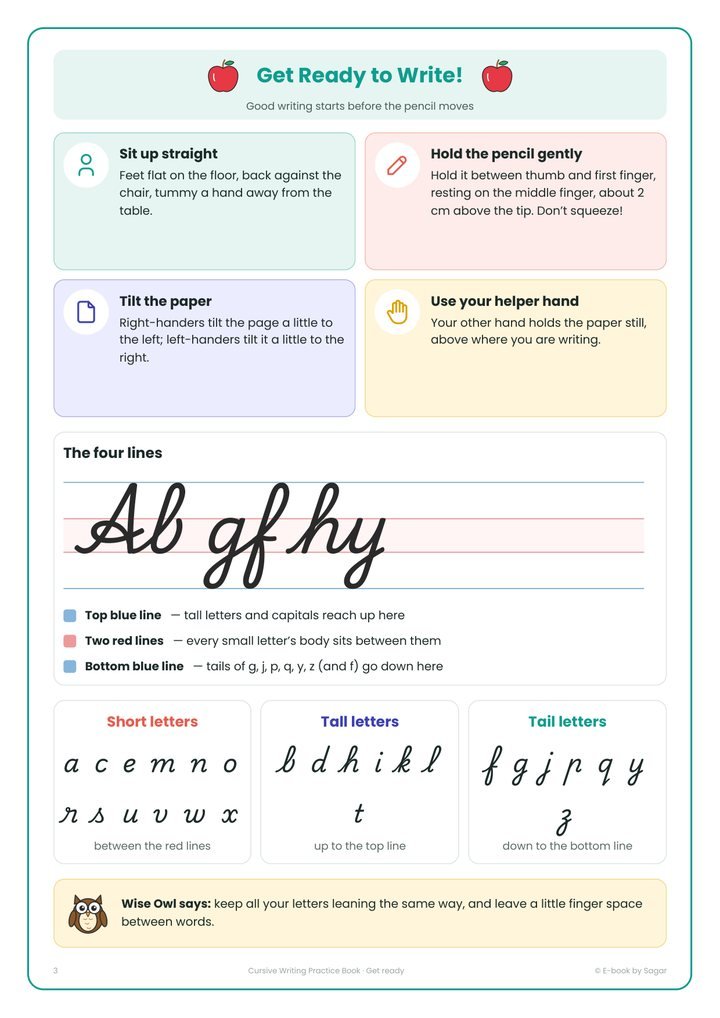
The pencil should rest between thumb and first finger, supported by the middle finger, about 2 cm above the tip. Our step-by-step pencil grip guide shows how to correct it without nagging.
2. Check posture and table height
Feet flat on the floor, back against the chair, forearms resting on the table. If the table is at chest height, add a cushion.
3. Tilt the paper
Right-handers tilt the page slightly to the left; left-handers slightly to the right. The other hand holds the paper still.
4. Use four-line ruling
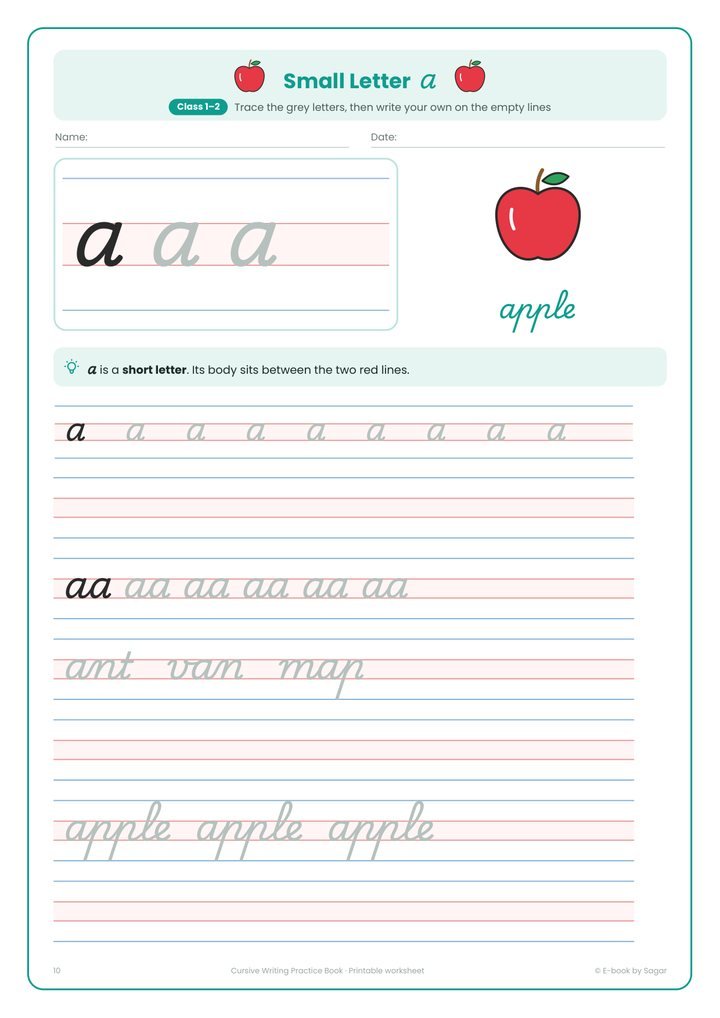
Four-line copies show exactly where each letter belongs: small letters between the two middle lines, tall letters up to the top line, tails down to the bottom line. Most messy writing is really letters of the wrong size.
5. Teach letters in families
Letters that start the same way are easier together: c, a, d, g, o, q all start with a “c” curve.
6. Leave a finger space
Words running into each other make writing look messier than it is. A finger-wide gap between words fixes it instantly.
7. Slow down
Neat first, fast later. Speed builds on its own once the shapes are automatic.
8. Build finger strength
Clay, pegs, tearing paper, threading beads and fine motor activities strengthen the small muscles that control a pencil.
9. Fifteen minutes a day
One short page every day beats an hour on Sunday. Stop while your child still wants to continue.
10. Praise one specific thing
“Your g’s tail touched the bottom line every time!” works far better than “Good”. Children repeat what you notice.
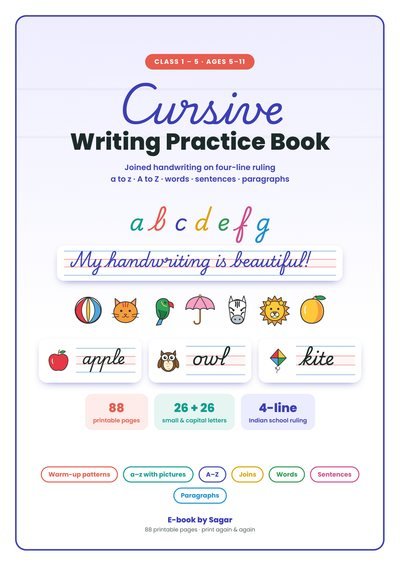 Our cursive book has four-line practice for every letter, joins, sentences and paragraphs — Class 1 to 5. See the Cursive Writing Practice Book (Class 1-5) →
3. A 15-minute daily routine
| Minutes | What to do |
|---|---|
| 0–2 | Warm up: finger stretches, or loops and waves on a slate |
| 2–10 | One practice page: trace three rows, then write two on your own |
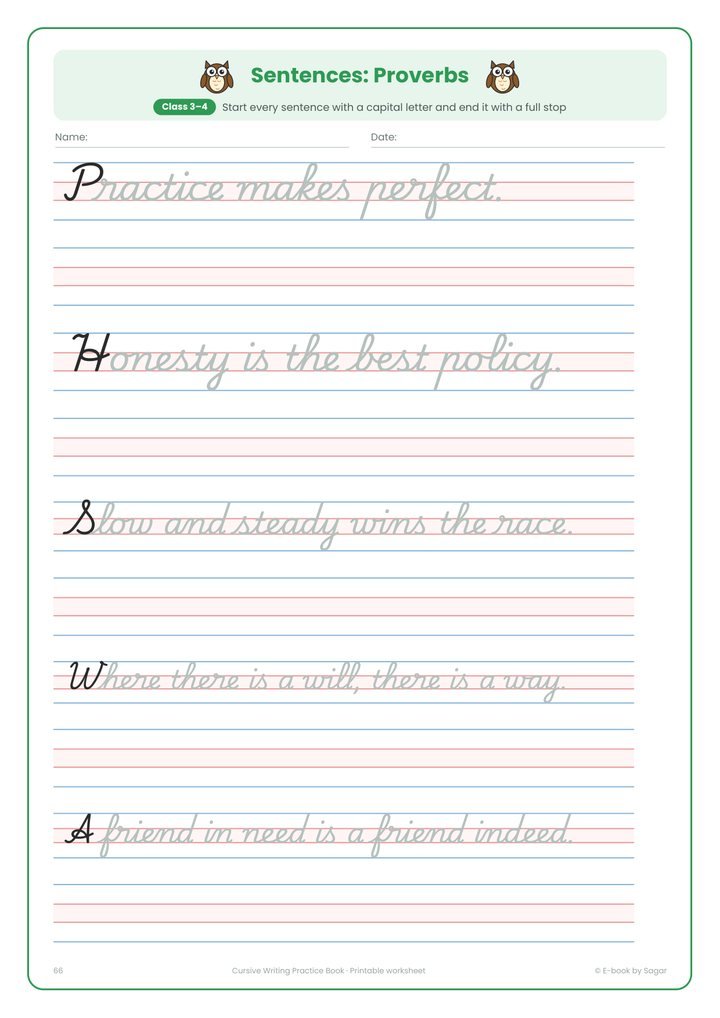
| 10–13 | Copy one sentence in best handwriting |
| 13–15 | Child circles their own best word and one to improve |
4. When to ask for help
Talk to the class teacher, a paediatrician or an occupational therapist if, after a few months of regular practice, your child:
- Still finds writing painful or avoids it strongly
- Holds the pencil very tightly or in a fist past age 6–7
- Writes letters very unevenly even when copying slowly
These can be signs of a fine-motor difficulty such as dysgraphia, which responds well to early support.
Questions parents ask
How long does it take to improve handwriting?
With 15 minutes of daily practice most children show clear improvement in 4 to 6 weeks. Consistency matters more than the length of each session.
Should my child learn cursive to improve handwriting?
Many children find joined writing smoother and faster once they know the print letters. Follow what your child's school teaches.
Is a four-line notebook better than a single-line notebook?
For Class 1 to 3, yes. Four lines show where every letter sits, which fixes letter size, the most common cause of messy writing.
My child writes neatly slowly but messily when fast. What should I do?
That is normal. Keep practising slowly; speed comes once shapes are automatic. For homework, allow a little more time rather than rushing.
Cursive Writing Practice Book — Class 1 to 5, 88 pages
88 printable pages · four-line ruling
- Warm-up patterns, a–z with pictures, A–Z
- Joins, words, sentences and paragraphs
- Blank four-line sheets you can print again and again
Print as many times as you like · Buy any 2 packs together and get 10% off