
Cursive writing for kids: how to teach joined handwriting, a to z
Most Indian schools introduce cursive (joined) writing somewhere between Class 1 and Class 3. Done well, it makes writing smoother and faster. Done in a rush, it creates letters that wobble between print and cursive. This guide gives you the calm, proven order.
On this page
1. When should a child start cursive?
A child is ready when they can write all print letters, hold a pencil comfortably and draw smooth loops. For most children that is Class 1 or 2 (around age 6–7). If the school has already started, simply support what is being taught in class.
2. Start with warm-up patterns
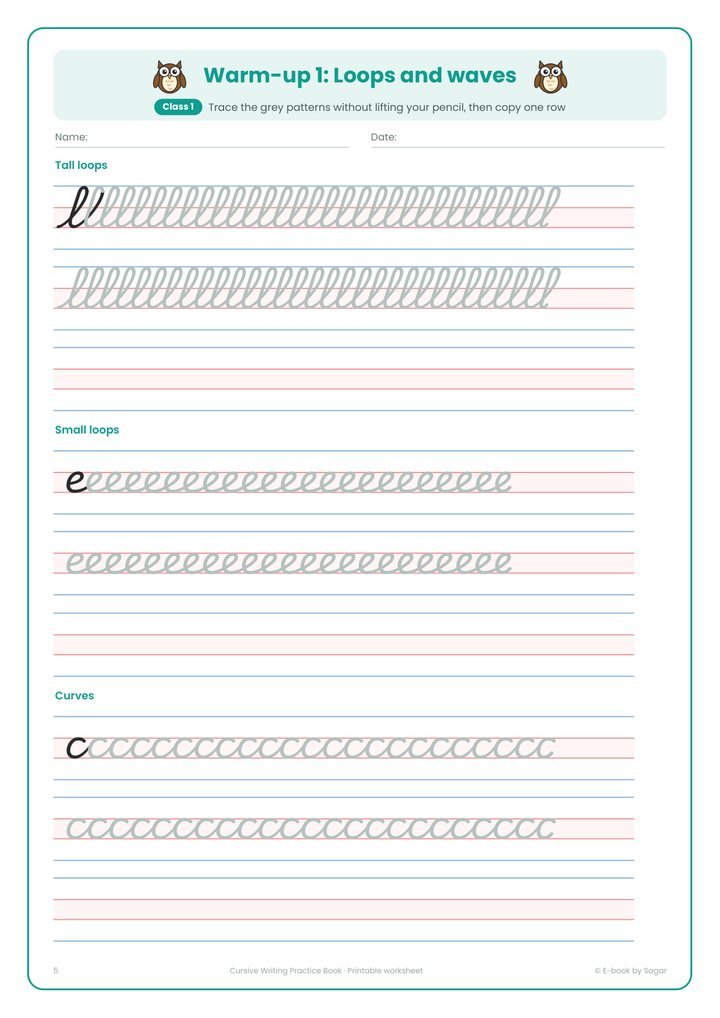
Cursive is made of a handful of movements. Practise them as continuous patterns before any letters:
- Loops: llllll (tall) and eeeeee (small)
- Humps: nnnn and mmmm
- Cups: uuuu
- Ovals and swings: oooo, wwww
3. The best order for small letters
Teach letters that share a starting movement together. It feels faster and children make fewer mistakes:
| Group | Letters | Shared movement |
|---|---|---|
| Swing-up letters | i, t, u, w, j | Up from the bottom line, straight down |
| Curve letters | c, a, d, g, o, q | Start with a “c” curve |
| Loop letters | e, l, b, h, k, f | A loop that leans to the right |
| Hump letters | n, m, v, x, y, z | Over the hill |
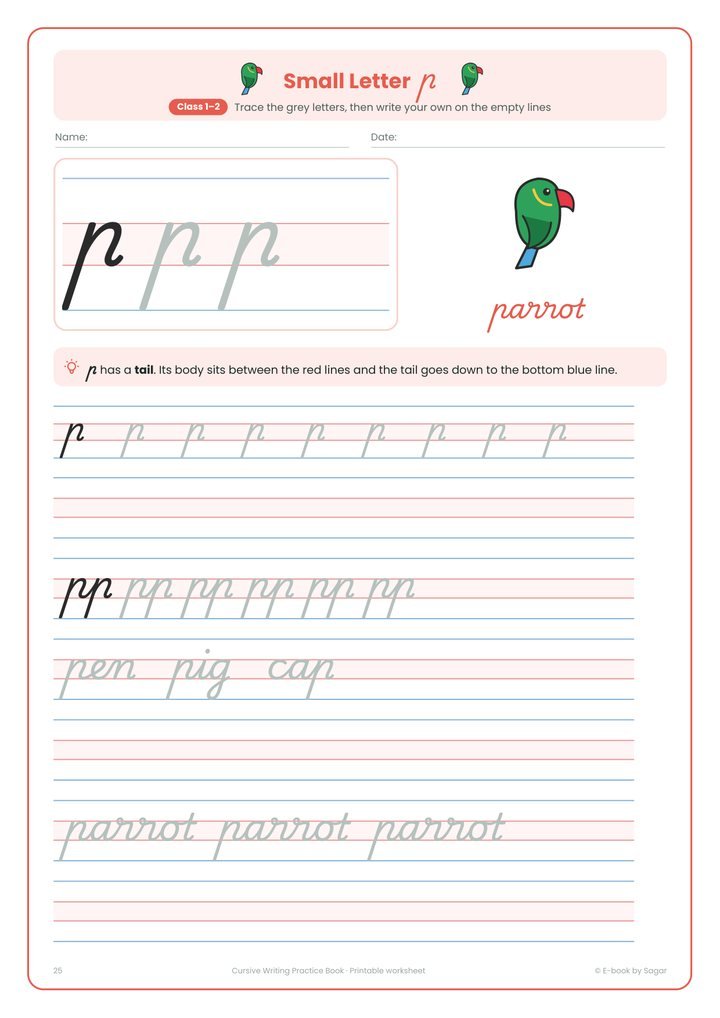
| Special shapes | r, s, p | Practise on their own |
On four-line ruling, small letters sit between the two middle lines, tall letters touch the top line and tails reach the bottom line.
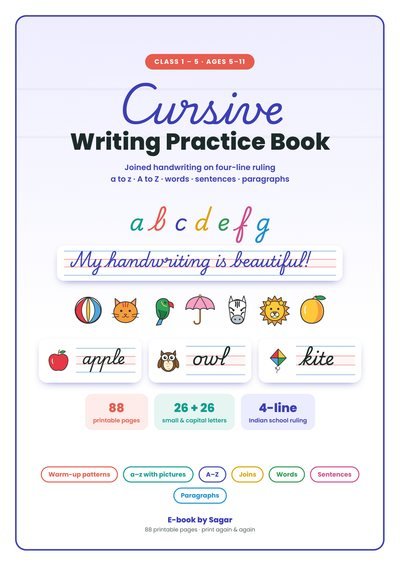 Practise every letter on its own page — model, tracing, joining, words and a picture word. See the Cursive Writing Practice Book (Class 1-5) →
4. Teaching the joins
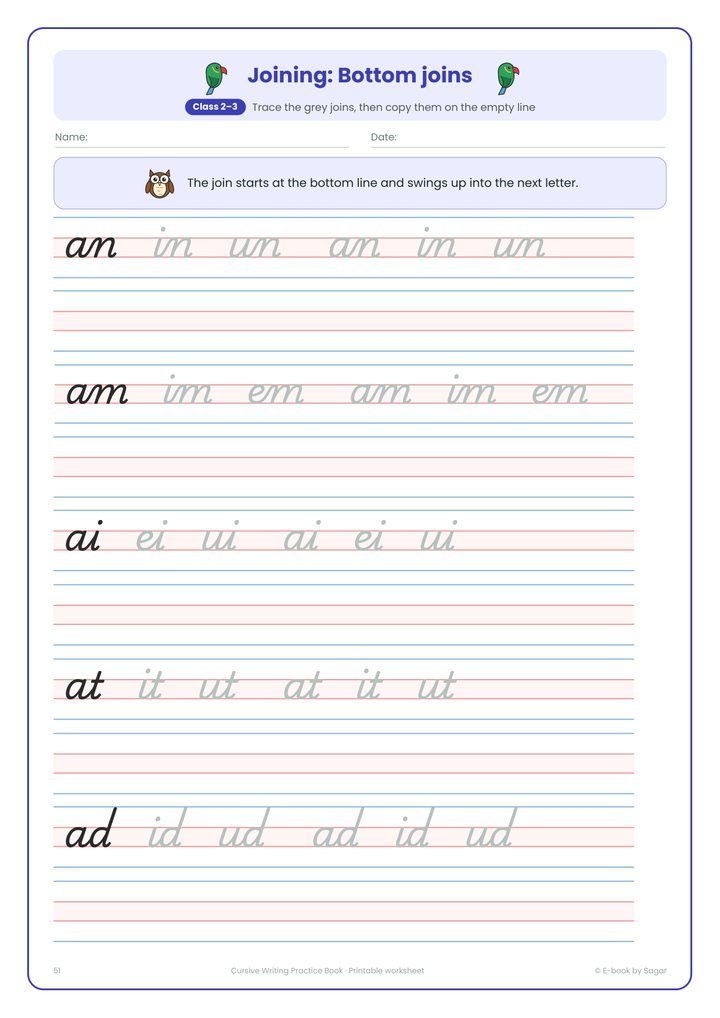
- Bottom joins (an, in, ut): the join starts on the bottom line and swings up.
- Top joins (on, ve, wa): after o, v, w and b the join leaves from the top of the letter, like a bridge.
- Double letters (ll, ee, oo, ss): both letters must be the same size.
- Tricky pairs (br, os, es): go slowly; these often get squashed.
5. Capital letters
Teach capitals after the small letters are comfortable. Practising them with names of people and places (Aman, Agra) reminds children that names always start with a capital.
6. A weekly plan (Class 1–2)
| Weeks | Focus |
|---|---|
| 1 | Warm-up patterns, 10 minutes a day |
| 2–6 | Small letters, one group per week |
| 7–8 | Joins and double letters |
| 9–11 | Capitals, then short words |
| 12+ | Sentences; Class 3–5 move on to paragraphs |
7. Common mistakes (and quick fixes)
- Letters of different sizes. Go back to four-line ruling and say “short, tall, tail” for each letter.
- Lifting the pencil inside a word. Practise joined patterns (eeee, llll) for a week.
- Different slants. Draw light slanted guide lines across the page until the slant becomes habit.
- Mixing print and cursive. Normal for a few weeks. Gently point to the cursive model.
- Pressing too hard. Use a soft HB pencil and do a few loops in the air first to relax the hand.
8. Tips for left-handed children
- Tilt the paper to the right and sit the child on the left side of a shared table.
- Hold the pencil a little higher up, so they can see what they have written.
- Let the slant be upright or slightly left — that is perfectly fine for left-handers.
- Never switch hands. It makes handwriting harder, not better.
Questions parents ask
At what age should a child learn cursive writing?
Most children start around age 6 to 7 (Class 1 or 2), once they can write all print letters comfortably.
Is cursive writing compulsory in Indian schools?
Many CBSE, ICSE and state board schools teach it in primary classes, but practice varies. Check with your child's school.
How many days does it take to learn cursive?
With 15 minutes a day, most children learn the small letters in 5 to 6 weeks and joins in another 2 to 3 weeks.
Should capital letters be taught first?
No. Small letters are used far more often. Teach capitals once the small letters and joins are comfortable.
Cursive Writing Practice Book — every letter on four-line ruling
88 printable pages · four-line ruling
- Warm-up patterns, a–z with pictures, A–Z
- Joins, words, sentences and paragraphs
- Blank four-line sheets you can print again and again
Print as many times as you like · Buy any 2 packs together and get 10% off