
Worksheets for 2, 3, 4 and 5 year olds: what to use at each age
Walk into any bookshop and you will find activity books labelled "age 3+" sitting next to ones labelled "age 3+" that look nothing alike. One asks for colouring inside a big circle, the other asks for the whole alphabet written on four lines. No wonder parents are unsure what a worksheet for a 3 year old should actually look like.
This guide sets it out age by age, in the order Indian preschools usually follow — playgroup, nursery, LKG and UKG — with how long each session should last and the signs that your child is ready to move up.
On this page
1. Do young children need worksheets at all?
Not in the sense of homework. A two or three year old learns mostly through play, talk and moving about, and no sheet of paper replaces that. What a good worksheet does is give that play a focus: a line to follow, a shape to colour, five apples to count. It builds the small hand muscles, the pencil grip and the habit of sitting with one task for a few minutes — all things a child needs on the first day of school.
The catch is that a worksheet only helps when it matches what the child can already do. Too easy and it is boring; too hard and it becomes a fight. The rest of this guide is about getting that match right.
2. Worksheets for 2 year olds
Playgroup / pre-nursery. At two, a child holds a crayon in a fist and moves the whole arm. That is normal. Worksheets at this age should be big, bold and almost impossible to get wrong.
- Colouring pages with thick outlines — one large picture per page, such as a ball, a fish or a mango
- Scribble and dot pages — pressing a thumb or a crayon onto big circles
- Standing and sleeping lines — from a dot at the top to a picture at the bottom
- Picture flashcards — not to read, but to point at and name
Give a thick crayon rather than a pencil, and stop the moment interest drops. Three minutes is a good session for a two year old.
3. Worksheets for 3 year olds (nursery)
This is the age most parents search for, and for good reason. Between three and four, children begin to use their fingers rather than their whole hand. It is the best window for tracing practice and for settling a correct pencil grip. (Our step-by-step guide on how to teach a child to hold a pencil covers the grip itself.)
Good worksheets for a 3 year old:
- Pre-writing strokes — standing, sleeping and slanting lines, curves, zig-zags and waves
- Shape tracing — circle, square, triangle, then colouring the shape
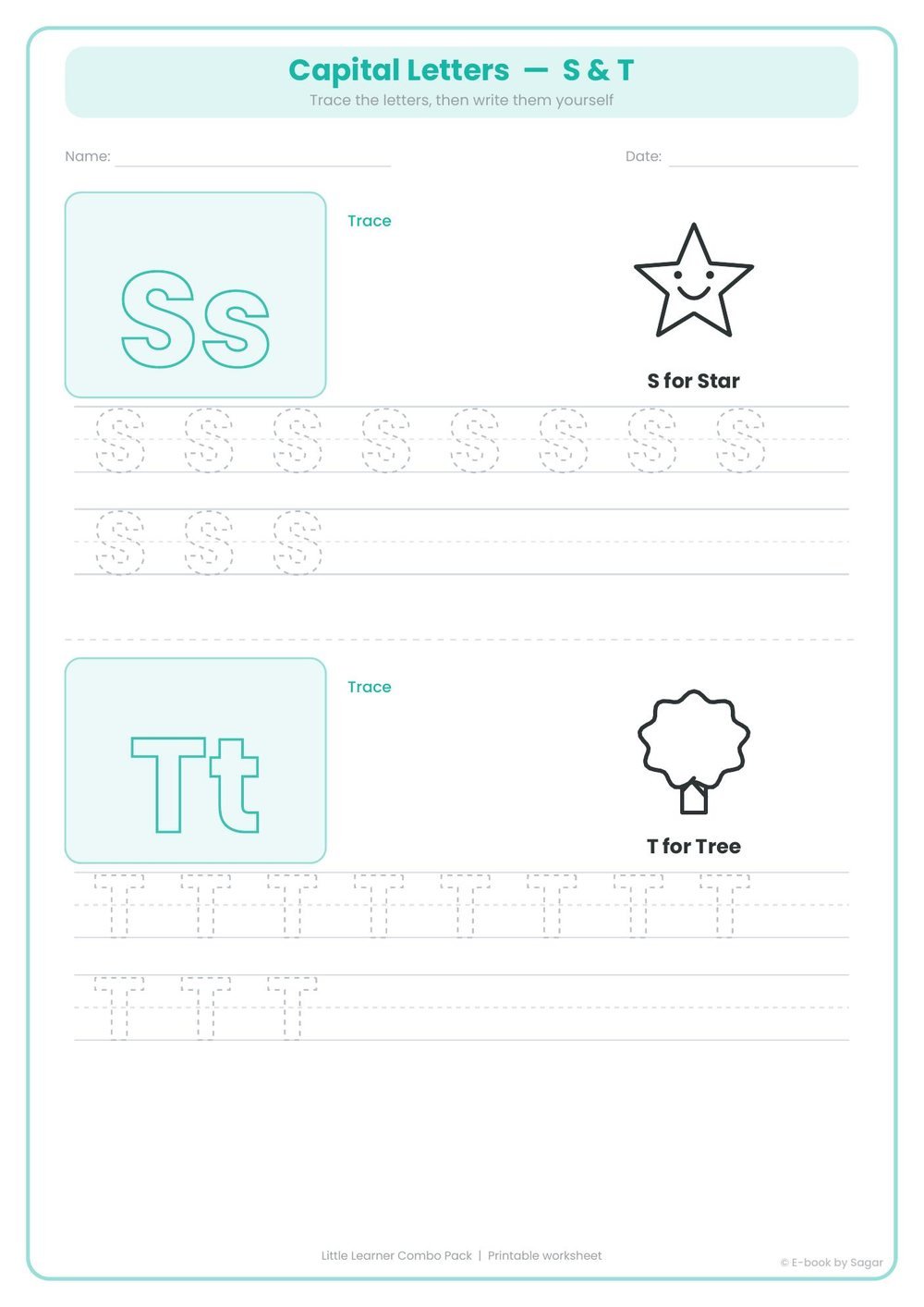
- Capital letter tracing — only once the strokes are comfortable, and with a picture for each letter (A for apple). Our guide on how to teach alphabets to kids explains the best order.
- Count and colour — "colour three balloons", counting objects up to 5, then 10
- Matching — same and different, big and small, the mother animal and her baby
Do not expect neat letters yet. If the line wanders off the dots but heads in the right direction, that is a success.
4. Worksheets for 4 year olds (LKG)
LKG, Junior KG or PP1. By four, most children can hold a pencil with their fingers and follow a dotted line reasonably well. LKG worksheets move from shapes to letters, sounds and numbers.
- Small letter tracing a–z, after the capitals
- Letter sounds — "circle the pictures that start with b"
- Number tracing 1–20 and count and write
- Before and after — which number comes after 7?
- More and fewer, tall and short, sorting by colour or size
- Simple mazes and dot-to-dot for pencil control
If you are wondering whether your child is on track for this stage, our checklist of what a child should know before LKG helps.
5. Worksheets for 5 and 6 year olds (UKG)
UKG, Senior KG or PP2 is the bridge to Class 1. Worksheets now ask a child to work with less help — fewer dots, more blank space.
- Writing letters and numbers without dots on four-line or two-line paper
- Three-letter words — cat, sun, pen — read and written
- Missing numbers up to 50 and later 100
- Picture addition and subtraction within 10
- Patterns, sequencing and simple puzzles
- Routine and reward charts that the child fills in themselves
6. How long should a session last?
A useful rule of thumb is two to three minutes for each year of age, and always stopping before the child wants to.
| Age | Class | One session | Main focus |
|---|---|---|---|
| 2 years | Playgroup | 3–5 minutes | Colouring, scribbling, big lines |
| 3 years | Nursery | 5–10 minutes | Strokes, shapes, capital letters |
| 4 years | LKG | 10–15 minutes | Small letters, numbers 1–20 |
| 5–6 years | UKG | 15–20 minutes | Words, missing numbers, addition |
One short session every day does far more than a long one on Sunday.
7. Making worksheet time go well
- Same time, same place. Straight after breakfast or after an afternoon nap works for many families.
- Let your child choose between two sheets. A small choice makes a big difference to cooperation.
- Mix one easy sheet with one new one. Starting with something they can already do builds confidence.
- Praise the effort, not the result. "You kept going right to the end" beats "beautiful".
- Print again. Doing the same sheet three times is not boring to a young child; it is how mastery feels.
- Put screens away first. A sheet cannot compete with a tablet in the same room. Our guide to reducing screen time has ideas.
Ready-made practice sheets, in the right order
The Little Learner Combo Pack has 150 printable worksheets for ages 2 to 6 — pre-writing strokes, alphabet and number tracing, colouring, early maths, flashcards and charts. Download once, print as often as you like.
See the worksheets pack — ₹49