
What should a child know before LKG? A realistic checklist
Admission season brings the same worry to most homes: is my child ready for LKG? Relatives compare notes, a neighbour's child already writes the whole alphabet, and school interview lists make it sound as if a four year old should know everything.
The reality is calmer. LKG exists to teach letters and numbers, so a child does not need to know them before walking in. What helps far more is a set of everyday skills — being able to sit for a short activity, follow a simple instruction and manage a lunch box. This checklist covers what matters, what does not, and how to practise at home.
On this page
1. What is the right age for LKG?
Most schools in India admit children to LKG (also called Junior KG or PP1) when they are around four years old, with nursery at about three and UKG at about five. Under the National Education Policy 2020, these years form the "foundational stage", which ends with Class 1 at around six.
Cut-off dates differ between states and between boards, so always check with the school you are applying to. A few months either way makes little difference to how a child settles in.
2. The checklist
Treat this as a guide, not a test. Most children starting LKG can do most of these, and very few can do all of them.
Looking after themselves
- Says when they need the toilet, and manages with a little help
- Eats from a lunch box and drinks from a bottle without help
- Puts on shoes (velcro is fine) and hangs up a bag
- Washes and dries hands
Getting along with others
- Can be left with a teacher for a few hours after a settling-in period
- Takes turns and shares, at least some of the time
- Sits with a group for a story or a song for about 10 minutes
Talking and listening
- Says their full name, and ideally a parent's name
- Speaks in short sentences and can be understood by an adult outside the family
- Follows a two-step instruction: "take your bottle and put it on the table"
- Knows a few rhymes and enjoys being read to
Hands and pencil
- Holds a crayon with fingers rather than a fist (see how to teach pencil grip)
- Draws standing and sleeping lines and a rough circle
- Colours a big picture, even if it goes outside the lines
- Tears paper, rolls dough, and is starting to use child-safe scissors
Early numbers and letters
- Counts aloud to 10, even if some numbers get skipped
- Counts three or four real objects correctly
- Recognises some letters, especially the first letter of their own name
- Names common colours and the basic shapes: circle, square, triangle
- Understands big and small, more and less, up and down
3. What your child does not need to know
Some things turn up on admission forms and in family conversations that simply are not needed before LKG:
- Writing the full alphabet — LKG is where this is taught
- Writing numbers to 100 — counting to 10 or 20 aloud is plenty
- Reading words — recognising a few letters is enough
- Spelling their name — recognising it is enough
- Sitting still for half an hour — ten minutes is a realistic target
Pushing written work too early often backfires. A child who has been made to write before their hands are ready tends to grip the pencil awkwardly and decide that writing is unpleasant.
4. How to practise at home
Fifteen minutes a day, spread across play, covers almost everything on the list.
- Daily chores. Setting out plates, sorting socks by colour and counting spoons build counting, colours and independence together.
- Read aloud every night. Point at pictures, ask "what happens next?", and let your child "read" the story back from the pictures.
- Play with dough, pegs and beads. These build the finger strength a pencil needs.
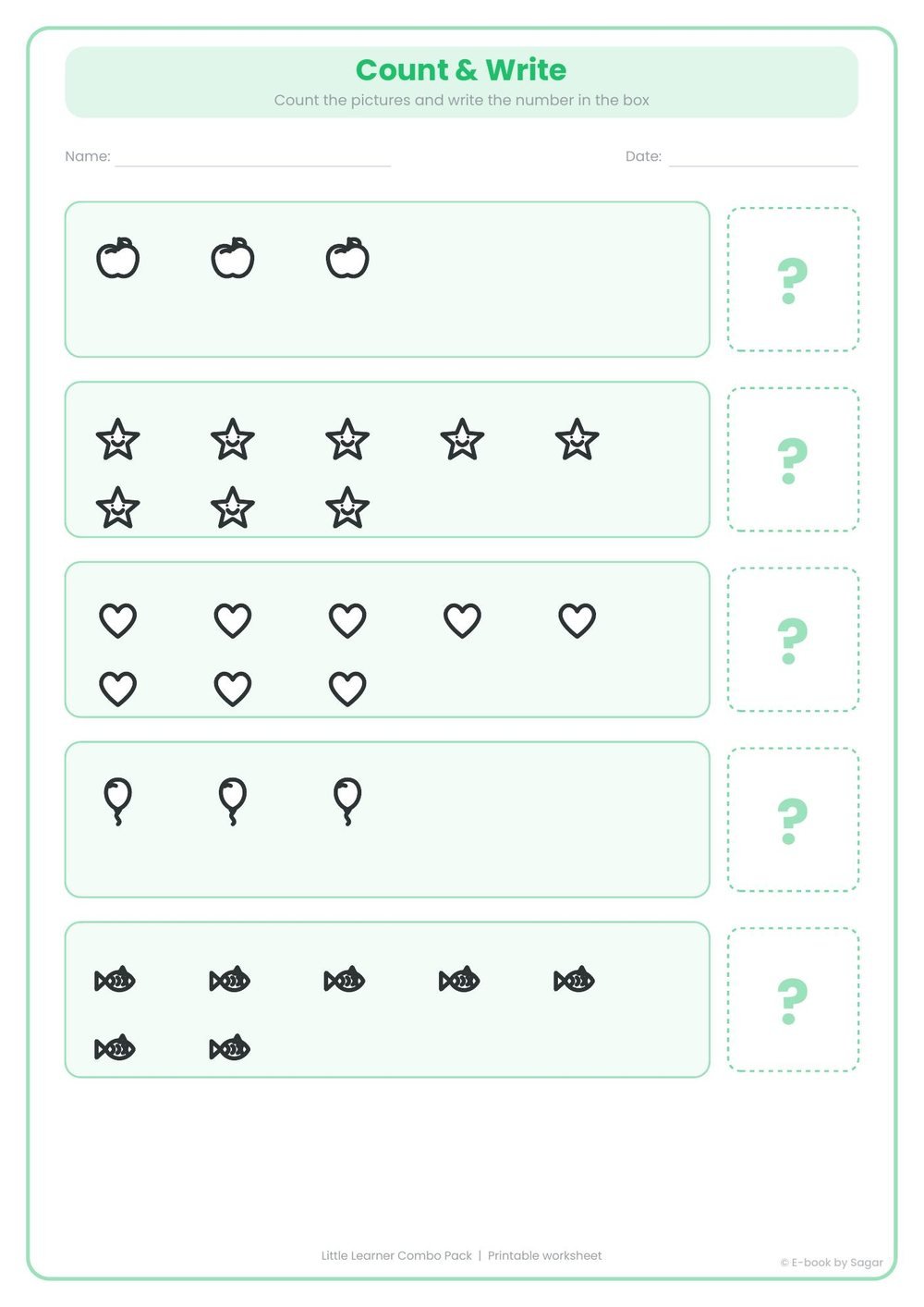
- One or two worksheets a day. Pre-writing strokes, shape tracing, capital letters and count-and-colour pages are right for this stage. Our age guide to worksheets for 3 and 4 year olds explains what to pick.
- Practise the school routine. Pack a lunch box at home, open it at the table, close it and put it away.
- Talk about school positively. Walk past the school, meet the teacher if you can, and read stories about the first day.
5. What comes next in UKG
After a year of LKG, most children arrive in UKG (Senior KG or PP2) able to write capital and small letters with some help, count and write numbers to 20 or beyond, and recognise simple sounds. UKG then builds three-letter words, missing numbers, simple addition and longer writing — the base for Class 1.
Every child gets there at their own pace. A calm routine at home, a few minutes of practice each day and plenty of reading aloud do more than any crash course before admission.
Ready-made practice sheets, in the right order
The Little Learner Combo Pack has 150 printable worksheets for ages 2 to 6 — pre-writing strokes, alphabet and number tracing, colouring, early maths, flashcards and charts. Download once, print as often as you like.
See the worksheets pack — ₹49