
Vedic maths for kids: 6 easy tricks, with examples and why they work
“Vedic maths” classes are everywhere now, and parents often ask us two questions: is it worth it, and can I teach it at home? The short answers are yes, a few tricks are genuinely useful, and yes, you can — most take a few minutes to learn.
Below are the six tricks we think give children the most value, each with a worked example and a plain explanation of why it works, so it supports school maths instead of replacing it.
On this page
1. What is Vedic maths?
Vedic maths is a set of 16 short rules (sutras) and 13 sub-rules for fast calculation, published in 1965 in the book Vedic Mathematics by Jagadguru Swami Bharati Krishna Tirthaji. He said the sutras came from the Vedas; historians debate that, but the tricks themselves are correct maths and many children find them fun. Think of Vedic maths as a toolbox of shortcuts — not a different kind of maths.
2. All from 9, last from 10 (Nikhilam)
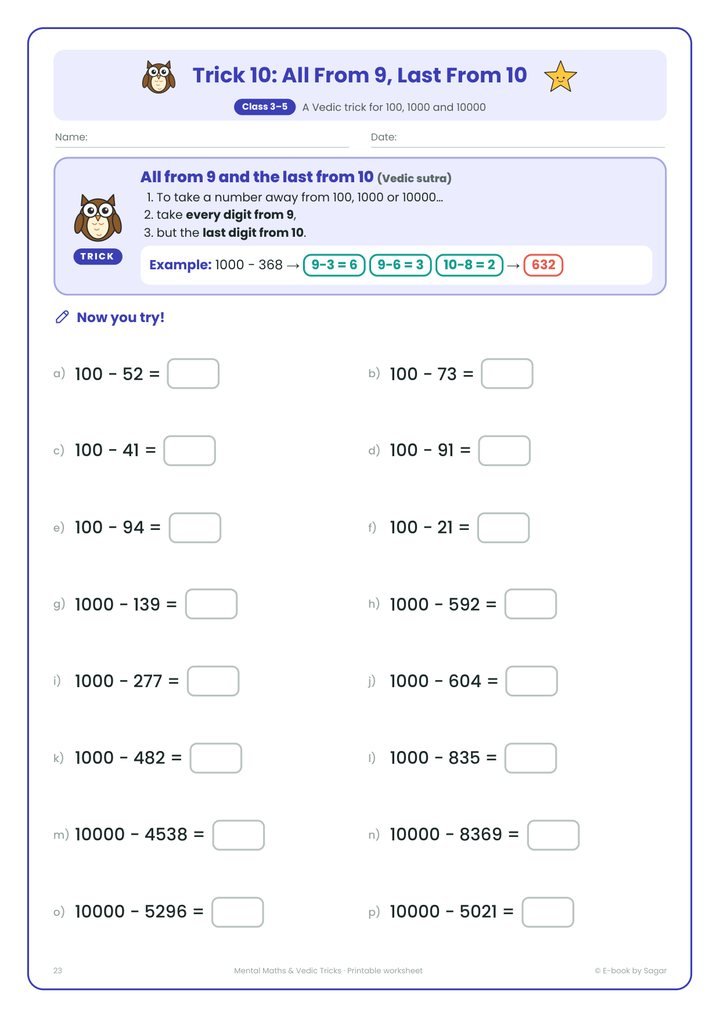
To subtract any number from 100, 1000 or 10000: take every digit from 9 and the last digit from 10.
Example: 1000 − 368 → 9−3 = 6, 9−6 = 3, 10−8 = 2 → 632. No borrowing at all.
Why it works: 1000 = 999 + 1. Subtracting from 999 never needs borrowing (each digit is from 9), and the extra 1 goes on the last digit.
Tip: if the number ends in 0, like 1000 − 370, ignore the zero: 100 − 37 = 63, then put the 0 back → 630.
3. Squares of numbers ending in 5 (Ekadhikena Purvena)
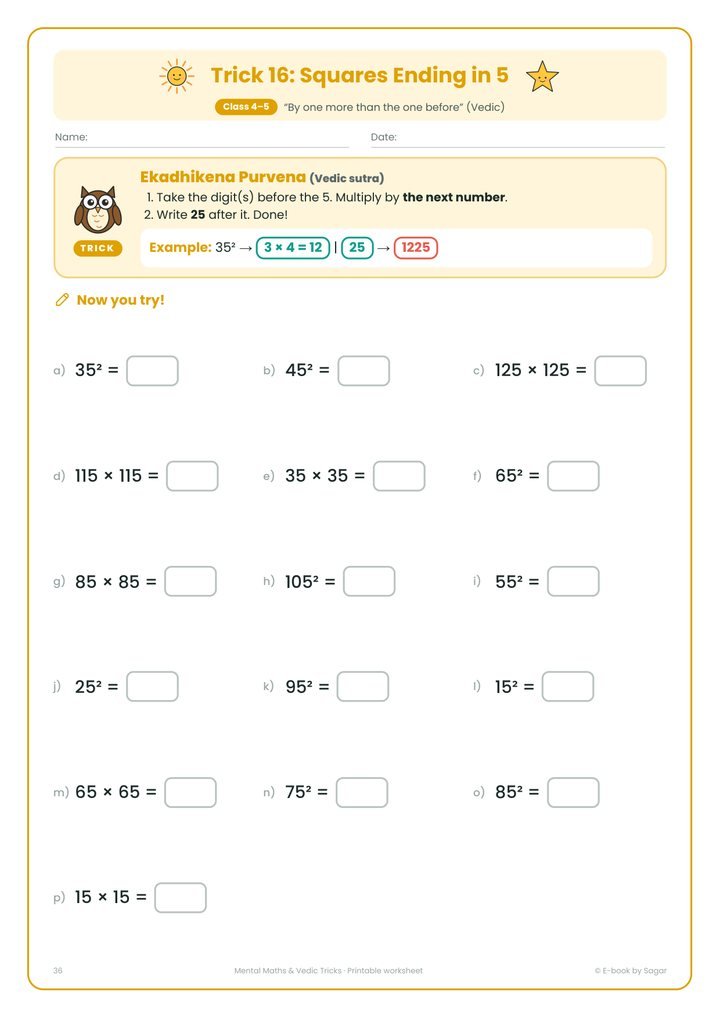
The sutra means “by one more than the one before”. Take the digits before the 5, multiply by the next number, then write 25.
Examples: 35² → 3 × 4 = 12 → 1225. 85² → 8 × 9 = 72 → 7225. 105² → 10 × 11 = 110 → 11025.
Why it works: (10a + 5)² = 100a² + 100a + 25 = 100 × a(a + 1) + 25.
4. The base method near 10
For big single digits, like 8 × 7: write how far each is below 10 (2 and 3). Cross-subtract: 8 − 3 = 5 (or 7 − 2 = 5 — always the same). Multiply the gaps: 2 × 3 = 6. Answer 56.
This is a great rescue for children who keep forgetting the 7, 8 and 9 tables. If the gaps multiply to 10 or more (like 6 × 6: gaps 4 and 4 = 16), carry the 1: 2 | 16 → 36.
5. The base method near 100
The same idea for numbers just below 100. 97 × 96: gaps 3 and 4. Cross-subtract: 97 − 4 = 93. Multiply gaps: 3 × 4 = 12. Answer 9312.
Write the right part as two digits: 98 × 97 → 95 | 06 → 9506.
Why it works: (100 − a)(100 − b) = 100(100 − a − b) + ab.
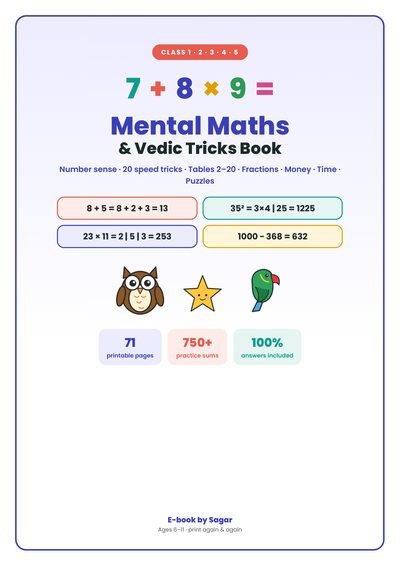 Each of these Vedic tricks has its own practice page in our book, next to 14 everyday mental maths tricks, with answers. See the Mental Maths & Vedic Tricks Book (Class 1-5) →
6. Times 11
For a two-digit number, write the two digits apart and put their sum in the middle: 52 × 11 → 5 (7) 2 = 572. If the sum is 10 or more, carry: 68 × 11 → 6 (14) 8 → 748.
7. Check answers with digit sums
Add up the digits of each number until you get one digit (9 counts as 0). Do the same sum with these small numbers. If the result does not match the digit sum of your answer, the answer is wrong.
Example: 23 × 14 = 322? Digit sums: 2+3 = 5 and 1+4 = 5; 5 × 5 = 25 → 2+5 = 7. Answer: 3+2+2 = 7. They match, so 322 is very likely right. (The check catches most mistakes, but not all — swapped digits still pass.)
8. When and how to start
| Class | Start with |
|---|---|
| Class 3 | All from 9 last from 10 (from 100); base method near 10 |
| Class 4 | Times 11; subtracting from 1000; squares ending in 5 |
| Class 5 | Base method near 100; digit-sum checks |
Children should know their tables up to 10 and place value well before starting. Teach one trick, practise it for three or four days, then add the next.
Questions parents ask
Is Vedic maths good for kids?
Yes, in moderation. A handful of tricks build number sense and confidence. It should sit alongside school maths, not replace the methods taught in class.
At what age can a child learn Vedic maths?
Around 8–9 years (Class 3–4), once they know tables up to 10 and are comfortable with place value.
Is Vedic maths really from the Vedas?
The sutras were presented by Bharati Krishna Tirthaji in his 1965 book. Scholars have not found them in the Vedic texts, but the tricks themselves are mathematically correct.
Can I use Vedic maths in school exams?
Yes. The answers are the same. Where a question asks for working, show the method your teacher expects.
Mental Maths & Vedic Tricks Book (Class 1–5)
71 printable pages · Class 1 to 5
- 20 speed tricks incl. Vedic maths, one per page
- Tables 2–20, 6 timed drills, fractions, money, time
- 760+ sums, puzzles and a full answer key
Print as many times as you like · Buy any 2 packs together and get 10% off