
Kids bedtime calculator: what time should my child go to bed?
What time should your child go to bed? The honest answer is: it depends on when they need to wake up, how old they are, and whether they still nap. This free kids bedtime calculator does the maths for you. Enter your child's age, wake-up time and nap length, and it shows the ideal bedtime based on the sleep hours recommended by paediatric sleep experts, plus when to start the bedtime routine and switch off screens.
Kids bedtime calculator
Recommended sleep hours are from the American Academy of Sleep Medicine guidelines, endorsed by the American Academy of Pediatrics.
On this page
- How to use the bedtime calculator
- How much sleep children need
- Bedtime chart by age and wake-up time
- Why sleep matters so much for young children
- Signs your child is not getting enough sleep
- A simple bedtime routine that works
- How to move bedtime earlier
- Naps by age
- Sample daily schedules
- Common bedtime problems and fixes
- Sleep tips for real family life
- Questions parents ask
1. How to use the bedtime calculator
- Choose your child's age group. Sleep needs change a lot in the first few years.
- Enter the wake-up time your child actually needs on a normal day, for example the time they must get up for school.
- Choose total nap time. Add up all daytime naps. If your child does not nap, choose "No nap".
- Tap "Find bedtime". You will see the ideal lights-out time, the healthy range, when to switch off screens and when to start the bedtime routine.
The calculator works backwards from the wake-up time. It takes the recommended total sleep for your child's age, subtracts nap time, and uses the middle of the recommended range as the ideal night's sleep. Nothing you enter is stored or sent anywhere.
2. How much sleep children need
In 2016, the American Academy of Sleep Medicine published consensus recommendations on children's sleep, which the American Academy of Pediatrics endorsed. They are now widely used by paediatricians around the world. The hours below are total sleep in 24 hours, including naps:
| Age | Recommended sleep per 24 hours |
|---|---|
| Infants, 4 to 12 months | 12 to 16 hours |
| Toddlers, 1 to 2 years | 11 to 14 hours |
| Preschoolers, 3 to 5 years | 10 to 13 hours |
| School-age, 6 to 12 years | 9 to 12 hours |
| Teenagers, 13 to 18 years | 8 to 10 hours |
These are ranges because children differ. Some three year olds are happy and alert on 10 hours; others need nearly 13. Your own child's mood, energy and behaviour are the best guide to where they sit in the range.
3. Bedtime chart by age and wake-up time
A quick reference, assuming typical naps for each age (about 2 hours for 1 to 2 year olds, 1 hour for 3 to 5 year olds, and none for 6 to 12 year olds). Times show the ideal lights-out:
| Wake-up time | 1–2 years | 3–5 years | 6–12 years |
|---|---|---|---|
| 6:00 AM | 7:30 PM | 7:30 PM | 7:30 PM |
| 6:30 AM | 8:00 PM | 8:00 PM | 8:00 PM |
| 7:00 AM | 8:30 PM | 8:30 PM | 8:30 PM |
| 7:30 AM | 9:00 PM | 9:00 PM | 9:00 PM |
| 8:00 AM | 9:30 PM | 9:30 PM | 9:30 PM |
Notice that bedtime stays similar across these ages: younger children need more total sleep, but they also nap more. If your child naps less than this, or not at all, use the calculator; bedtime will be earlier.
4. Why sleep matters so much for young children
Sleep is not just rest. During sleep, a child's brain and body do essential work:
- Memory and learning: during sleep, the brain consolidates what was learnt during the day — new words, letters, numbers and skills.
- Attention and behaviour: well-rested children find it easier to concentrate, wait their turn and manage frustration. Many "behaviour problems" improve with more sleep.
- Growth: growth hormone is released in pulses, with a large share during deep sleep at night. See our child height predictor for more on growth.
- Immunity: regular, sufficient sleep supports the immune system.
- Emotional health: tired children have more meltdowns, and are more anxious and irritable.
Studies have linked regular short sleep in childhood with more attention and behaviour difficulties and a higher risk of excess weight. The good news is that sleep is one of the easiest things for parents to improve.
5. Signs your child is not getting enough sleep
- Hard to wake in the morning, or very grumpy on waking.
- Falls asleep in the car or in front of the TV on most days.
- Frequent meltdowns, especially in the late afternoon.
- Hyperactive, "wired" behaviour in the evening (overtired children often seem to have more energy, not less).
- Trouble concentrating, or teachers mention tiredness at school.
- Sleeps much longer at weekends than on weekdays.
If you notice several of these, try moving bedtime 15 to 30 minutes earlier for two weeks and watch for changes. If your child snores loudly most nights, stops breathing briefly during sleep, or seems exhausted despite enough hours in bed, talk to your paediatrician.
6. A simple bedtime routine that works
Children fall asleep more easily when the last 30 to 45 minutes of the day follow the same calm steps, in the same order, every night. A routine that works for many families:
- Screens offAbout an hour before lights out. Bright screens and exciting content make it harder to fall asleep.
- Light snack or milkIf dinner was early. Then brush teeth.
- Bath or washA warm wash, then pyjamas. Lights dimmed around the house.
- Toilet and tidy-upLast toilet trip; put tomorrow's clothes and school bag ready.
- Story timeOne or two books in bed. Reading aloud is also one of the best things you can do for language.
- Lights outA short chat, a cuddle, the same goodnight words, and lights out.
Six calm steps in the same order every night
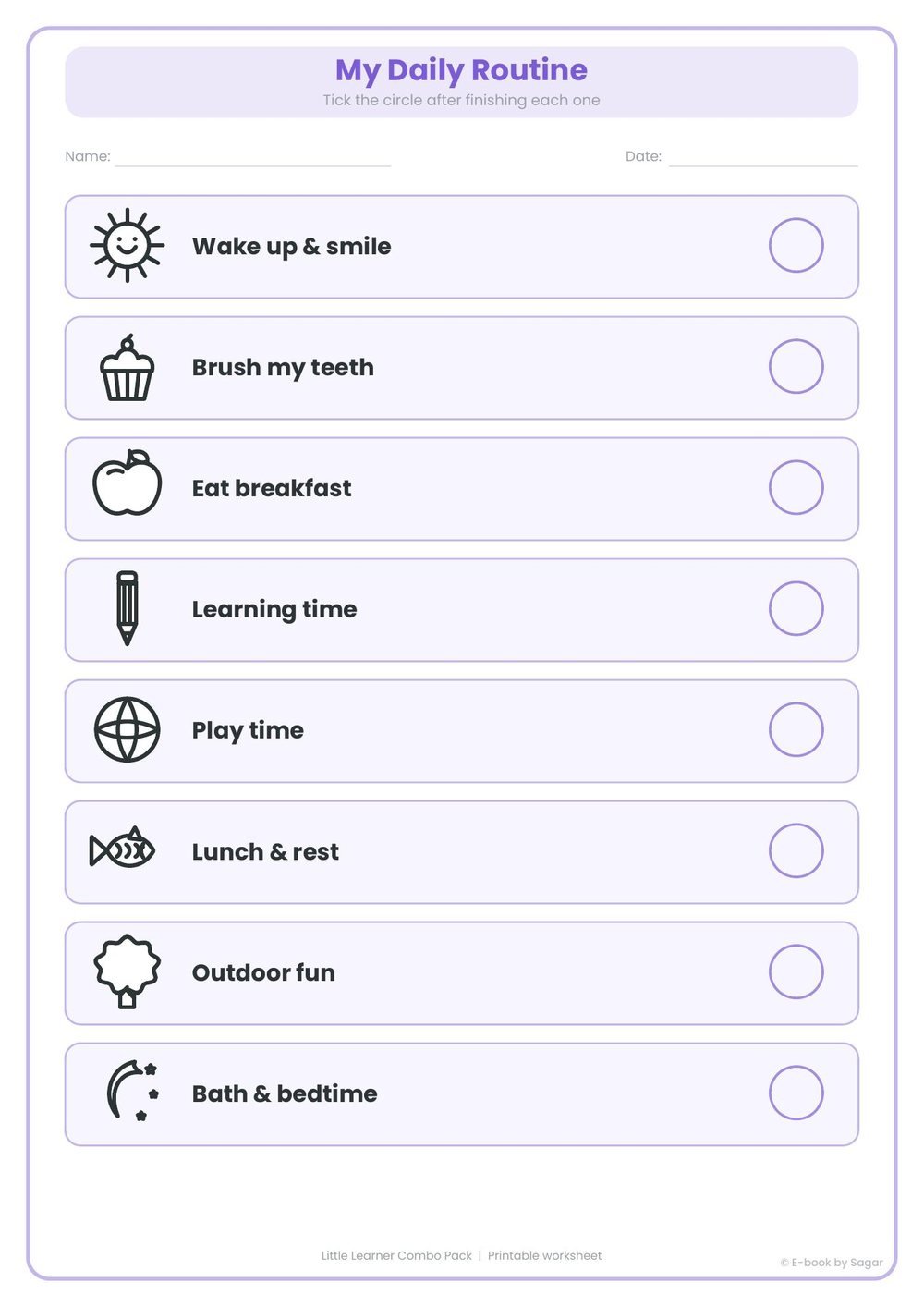
Young children love seeing their routine. A picture chart showing each step, where they can tick or move a marker, gives them a sense of control and cuts down on bedtime arguments.
7. How to move bedtime earlier
If the calculator shows a bedtime much earlier than your child's current one, do not change it overnight. A sudden jump of an hour usually means lying awake and a battle. Instead:
- Move bedtime 15 minutes earlier every 3 to 4 days until you reach the target.
- Move wake-up time too, especially on weekends. A consistent wake-up time is what really sets the body clock.
- Get morning daylight. Outdoor light soon after waking helps the body feel sleepy earlier at night.
- Bring dinner forward so the routine can start on time.
- Keep the last hour calm and screen-free. Swap screens for colouring, puzzles, books or quiet play. Our guide to keeping kids busy without a mobile has ideas.
- Use a reward chart for the first couple of weeks: a sticker for each night in bed on time.
The same approach works before school starts after a long holiday. Begin two weeks before the first day.
8. Naps by age
| Age | Typical naps |
|---|---|
| 4 to 12 months | 2 to 3 naps a day, 2 to 4 hours in total |
| 1 to 2 years | Usually moves from 2 naps to 1 nap of 1.5 to 3 hours |
| 3 to 5 years | Many still nap 1 hour or so; many stop between 3 and 5 |
| 6 years and up | Most no longer nap; quiet rest time can still help |
Signs a child is ready to drop the nap: taking a long time to fall asleep at nap time, or naps pushing bedtime very late. When a nap is dropped, move bedtime earlier for a few weeks to cover the lost sleep. A "quiet time" of 30 to 45 minutes with books or colouring keeps the afternoon calm even without sleep.
Bedtime and screens
Screens are one of the biggest causes of late bedtimes. Bright light from phones and tablets can delay the body's sleep signals, and exciting videos or games make it hard to wind down. Try to keep screens out of the bedroom and switch them off about an hour before bed. Our screen time calculator shows how daily screen time adds up over a year.
9. Sample daily schedules by age
Seeing a whole day can make the bedtime feel more realistic. These examples assume a 7 am wake-up. Shift every time if your mornings start earlier or later.
Two year old (one nap)
| 7:00 AM | Wake up, breakfast |
| 9:30 AM | Outdoor play or an outing |
| 12:00 PM | Lunch |
| 12:45 – 2:45 PM | Nap (about 2 hours) |
| 5:30 PM | Early dinner |
| 7:30 PM | Bath, story, routine begins |
| 8:00 – 8:30 PM | Lights out |
Four year old (short nap or quiet time)
| 7:00 AM | Wake up, breakfast, preschool |
| 1:30 – 2:30 PM | Nap or quiet time with books |
| 4:30 PM | Outdoor play |
| 6:00 PM | Short worksheet or colouring session |
| 7:00 PM | Dinner |
| 8:00 PM | Routine begins |
| 8:30 PM | Lights out |
Six year old (no nap, school day)
| 6:30 AM | Wake up, get ready for school |
| 3:00 PM | Home, snack, free play |
| 5:30 PM | Homework or reading |
| 7:00 PM | Dinner, screens off |
| 7:45 PM | Routine begins |
| 8:15 PM | Lights out |
10. Common bedtime problems and simple fixes
"One more story, one more glass of water"
Stalling is extremely common. Build the requests into the routine (water and toilet before stories), offer a fixed number of stories, and use a calm, boring response to extra requests. Some families give a "bedtime pass" card that can be used once for one request.
Fear of the dark
Common from around age 3, when imagination takes off. A dim night light, a favourite soft toy, and a quick "check" of the room together can help. Avoid scary content in the evening.
Waking very early
Early rising is sometimes a sign of going to bed too late, not too early. Overtired children often sleep worse. Try a slightly earlier bedtime, blackout curtains, and a rule such as "stay in bed until the clock shows 6".
Night waking
Brief waking is normal. If your child cannot fall back asleep without you, gently encourage falling asleep independently at bedtime, which helps them settle themselves during the night too.
Bedtime battles after holidays or travel
Late nights during festivals, weddings and holidays are part of life. Return to the usual routine as soon as you can, and use the "15 minutes every few days" approach to get back on track.
11. Sleep tips for real family life
Sleep advice often assumes a quiet house, a separate bedroom and a perfectly predictable day. Real family life is rarely like that, especially in busy Indian households. Some practical tips:
Shared rooms and co-sleeping
Many children share a room or a bed with parents or siblings, and that is fine. Keep the routine the same, and if adults go to bed later, dim the lights and keep phones and TV out of the room once the child is asleep. A small fan or white-noise app can mask household sounds.
Late family dinners
If the family eats at 9 or 9:30 pm, give young children an early dinner around 7 pm and let them join the family table for a few minutes before bed, rather than waiting to eat.
Heat and mosquitoes
A cool, comfortable room helps children sleep. Use a fan or cooler, light cotton clothes, and a mosquito net or safe repellent so they are not woken by bites.
Grandparents and visitors
Evenings with visitors are lovely but can push bedtime late. Let your child say goodnight and then follow the usual routine, even if the adults continue.
Festivals and weddings
Occasional late nights are part of life. Let your child sleep a little later the next morning if possible, offer an extra nap or quiet time, and return to the usual bedtime as soon as you can.
Early school vans
If the school van comes at 6:45 am, the wake-up time may be 6 am. Put that time into the calculator; for a five year old, that usually means asleep by around 7:30 pm. It is early, but it makes school mornings far easier.
12. Questions parents ask
How many hours of sleep does a child need?
According to American Academy of Sleep Medicine guidelines endorsed by the American Academy of Pediatrics: 11 to 14 hours for ages 1 to 2, 10 to 13 hours for ages 3 to 5, and 9 to 12 hours for ages 6 to 12, including naps.
What time should a 4 year old go to bed?
It depends on wake-up time and naps. A 4 year old who wakes at 7 am and naps for about an hour would ideally be asleep around 8:30 pm. Without a nap, around 7:30 to 8 pm.
What time should a 5 year old go to bed for school?
Work back 10 to 13 hours from the school wake-up time. For a 6:30 am wake-up with no nap, that means asleep between about 5:30 and 8:30 pm, so around 7:30 to 8 pm is a practical target.
How do I move my child's bedtime earlier?
Move it 15 minutes earlier every 3 to 4 days, keep a consistent wake-up time, get morning daylight, bring dinner forward, and keep the last hour before bed calm and screen-free.
Should my child still nap?
Most children nap until somewhere between 3 and 5 years old, and most children over 6 do not need naps. If naps make bedtime very late, try shortening them or replacing them with quiet time.
How long before bed should screens be turned off?
About an hour before lights out is a good rule. Bright screens and exciting content can make it harder for children to fall asleep.