
Nursery worksheets: what to practise at age 3 to 4, with a 4-week plan
Nursery is the first real classroom for most children, and the first time many parents wonder: what exactly should my child be practising at home? Search for "nursery worksheets" and you will find thousands of random pages — some far too hard for a three year old, some too easy, most in no particular order.
This guide fixes that. It explains the nursery class syllabus most Indian schools follow, which kinds of worksheets suit children aged three to four, the order to use them in, and a simple four-week plan you can start tomorrow. It also shows you how to check your child's progress with a quick skills checklist.
On this page
1. What children learn in nursery class
Nursery (also called Pre-KG, PP1 in some states, or the first year of Balvatika under NEP) is for children aged roughly three to four. The syllabus varies between schools, but almost all of them cover the same five areas:
| Area | What it includes in nursery |
|---|---|
| Pre-writing | Standing, sleeping and slanting lines, curves, circles and zig-zags |
| English | Recognising capital letters A–Z, letter sounds, rhymes and picture vocabulary |
| Numbers | Counting to 10, recognising numerals 1–10, matching numbers to objects |
| Concepts | Colours, shapes, big and small, more and less, same and different |
| General awareness | Fruits, vegetables, animals, body parts, family, good habits |
Notice what is not on the list: writing full words, reading sentences or doing sums. Nursery is about recognising, matching, tracing and talking. Schools that push three year olds into writing pages of letters are going faster than most children's hands can follow. Our guide to fine motor skills explains why hand strength has to come first.
2. 7 types of nursery worksheets, in the right order
Good nursery worksheets follow the way a child develops: big movements first, then finer control, then symbols. Use them roughly in this order.
1. Colouring pages with thick outlines
The very first worksheets. Big, simple pictures — an apple, a fish, a car — with thick black outlines. Colouring strengthens the hand and teaches a child to stop at a boundary. Do not expect neatness: going outside the lines is normal at three.
2. Pre-writing stroke worksheets
Tracing standing lines (|), sleeping lines (—), slanting lines (/ and \), curves, circles and zig-zags. Every letter and number your child will ever write is built from these strokes, so they deserve several weeks of practice.
3. Shape tracing
Circle, square, triangle and rectangle. Tracing shapes combines strokes into closed figures and introduces shape names at the same time.
4. Matching and sorting sheets
Draw a line from the big elephant to the small elephant, match the red apple to the red box, circle the odd one out. These need no writing at all and build thinking skills.
5. Capital letter tracing A–Z
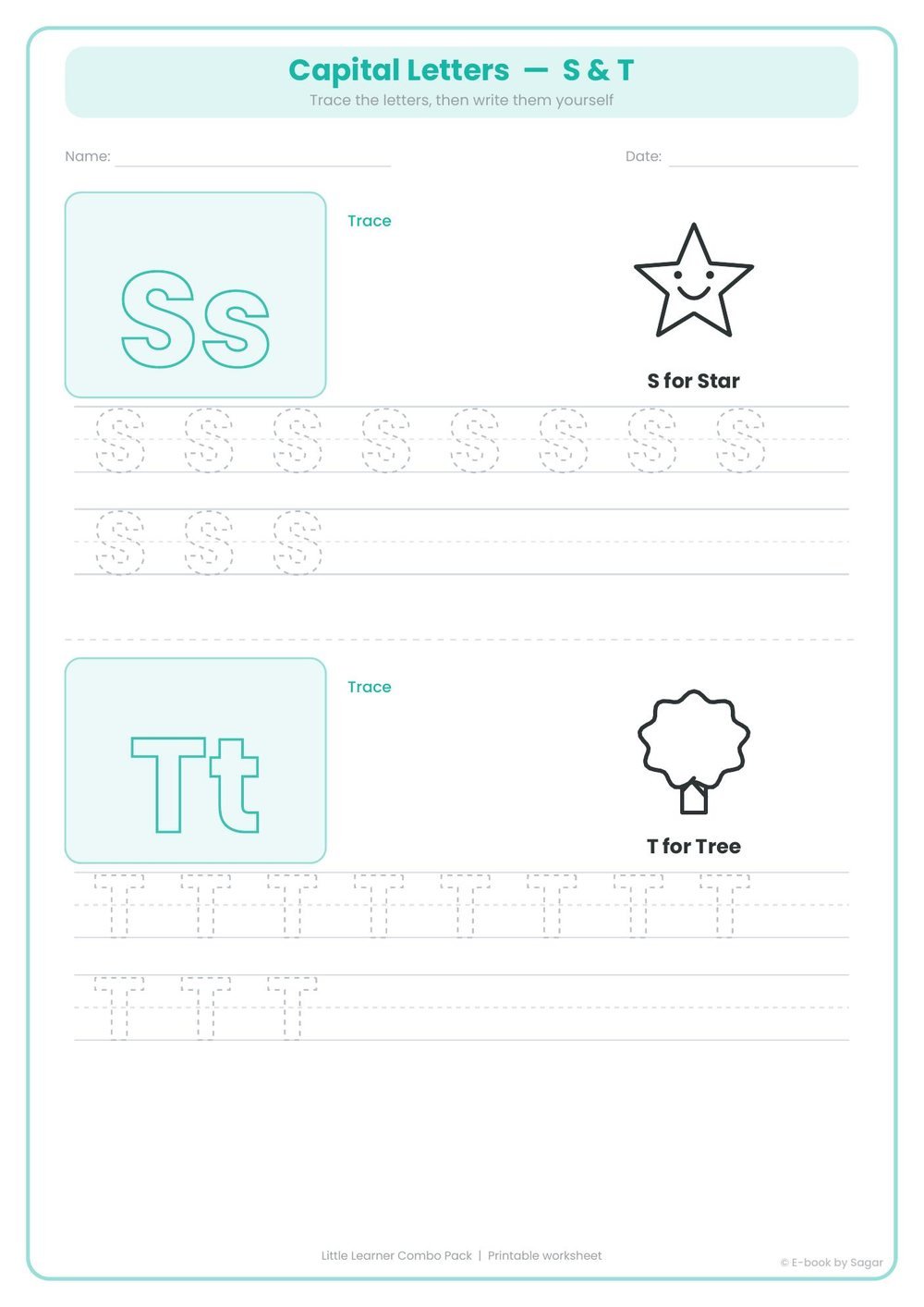
Large dotted capital letters, each with a picture: A for apple, B for ball. Capitals come first because they are built mostly from straight lines. Our guide on how to teach alphabets explains the best order.
6. Counting and number tracing 1–10
Count the pictures and colour that many boxes; trace the number. Always start with counting real things before writing numbers, as we explain in how to teach numbers to kids.
7. Flashcards and picture cards
Not worksheets exactly, but just as useful. Cut-out cards for letters, numbers, colours and shapes make perfect two-minute revision games.
3. Nursery skills checklist
Use this checklist to see where your child is and which worksheets to focus on. Tick what they can do comfortably. Your ticks are saved in this browser, so you can come back in a month and see the progress.
What can my nursery child do?
4. How to use worksheets with a 3 year old
A worksheet is only as good as the way it is used. These habits make the difference between a child who asks for "my paper" every morning and one who runs away from the table.
- One or two sheets a day is enough. Five to ten minutes is the right session length for a three year old. Stop while they are still enjoying it.
- Talk before you trace. "What is this? An apple! What colour is an apple? Let's trace the A for apple." Talking turns a page into a lesson.
- Use chunky crayons first. Thick crayons are easier to grip than pencils. Switch to a thick pencil once lines are steady.
- Show, then let them try. Trace the first line yourself, slowly, saying "start at the top, go down". Then hand over the crayon.
- Praise effort, not perfection. "You went all the way down to the bottom!" works far better than "That's wobbly."
- Mix paper with play. After tracing a letter, make it with dough or find it on a cereal box. Worksheets are strongest when they are part of a bigger routine.
- Same time, same place. A small table, a crayon box and the same time each day (after breakfast works well) build a habit quickly.
5. A 4-week nursery worksheet plan
Here is a simple plan to get started, about ten minutes a day, five days a week. Repeat any week your child found hard; there is no rush.
- Week 1: Colour and scribbleOne colouring page a day, plus standing and sleeping lines. Name the colours as you go.
- Week 2: Lines and curvesSlanting lines, curves and circles. Add one matching sheet (big and small) mid-week.
- Week 3: Shapes and first lettersShape tracing on two days; capital letters A, B, C with pictures on three days.
- Week 4: Counting and more lettersCount-and-colour sheets for 1 to 5 on two days; capital letters D to F on three days. Flashcard games every evening.
A four-week starter plan: ten minutes a day, five days a week
After four weeks, keep going at the same gentle pace: two or three new letters a week, numbers up to 10, and plenty of colouring for fun. By the end of the nursery year, most children who practise like this know most of their capital letters, can count to 10 and are ready for LKG worksheets.
6. Printing tips that save money
- Print in black and white. Your child does the colouring, so colour printing is wasted ink.
- Print a week at a time. Five or ten pages on Sunday, kept in a folder, means there is always something ready when boredom strikes.
- No printer? Use a print shop. Send the PDF on WhatsApp or carry it on a pen drive. Black and white printing at a local shop is cheap, and you only print what you need.
- Reuse with a sheet protector. Slide a favourite tracing sheet into a plastic sleeve and use a whiteboard marker. Wipe and repeat.
- Print favourites twice. Children love repeating a page they are good at. With a printable PDF, a second copy costs only the paper.
7. Questions parents ask
What should a nursery child learn?
Nursery children (about 3 to 4 years) learn pre-writing strokes, capital letters A to Z, counting to 10, colours, shapes, matching and basic general awareness like fruits and animals. Reading and writing words come later.
Which worksheets are best for nursery class?
Start with colouring pages and pre-writing strokes, then shape tracing, matching sheets, capital letter tracing with pictures, counting 1 to 10 and flashcards, in roughly that order.
How many worksheets should a 3 year old do in a day?
One or two sheets, five to ten minutes in total, is enough for a 3 year old. Stop while your child is still enjoying it.
Should a nursery child write letters?
Nursery children trace letters but are not expected to write them independently. Pre-writing strokes and hand-strength play come first; independent writing usually develops in LKG and UKG.
Can I print nursery worksheets without a printer?
Yes. Send the PDF on WhatsApp or carry it on a pen drive to a local print shop and print only the pages you need, in black and white.
Nursery, LKG and UKG worksheets in one PDF
The Little Learner Combo Pack has 150 printable pages for ages 2 to 6, arranged in the right order: colouring, pre-writing strokes, letter and number tracing, early maths, flashcards and charts. Pay once, print forever.
Get the worksheets pack — ₹49