
Activity books or printable worksheets? An honest comparison for parents
Walk into any bookshop or open any shopping app and you will find hundreds of activity books for preschoolers: tracing books, colouring books, "my first maths" books, sticker books. Search a little more and you will also find printable worksheet packs, free worksheet websites and learning apps. Every one of them says it is the best.
If you are trying to decide what to buy for your 2 to 6 year old, this guide compares the four main options honestly — activity books, printable worksheet packs, free worksheets online and learning apps — on cost, quality, convenience and how well each one actually teaches. There is also a calculator so you can see what each option costs your family over a year.
On this page
1. What to look for in any preschool practice material
Before comparing formats, it helps to know what makes practice material good for a young child, whatever form it comes in:
- Right order: pre-writing strokes before letters, capitals before small letters, counting objects before writing numbers. Random pages slow learning down.
- Age-appropriate: big pictures and thick lines for two and three year olds, smaller tracing and simple sums for five and six year olds.
- Pictures, not instructions: a child who cannot read yet should still understand what to do from the picture.
- Hands-on: real crayons and pencils on real paper build the hand control that writing needs.
- Enough of it: children need repetition. One page per letter is rarely enough.
- Original, child-safe artwork: clean illustrations without ads, cartoon characters or distracting clutter.
Keep these six points in mind as we go through each option. Our guide on which worksheets suit which age covers the "right order" point in detail.
2. Activity books: pros and cons
Printed activity and workbooks are what most of us grew up with, and they still have real strengths.
What is good about activity books
- No printer needed. Open and start.
- Full colour and good paper. Many look lovely and feel special to a child.
- Easy to carry for journeys and waiting rooms.
- A clear sense of progress as pages get filled.
Where activity books fall short
- Each page works once. When your child wants to trace the letter B again, or gets it wrong, there is no second copy.
- They run out fast. A keen four year old can finish a thin book in a week or two.
- One book covers one thing. You often need separate books for tracing, colouring, maths and alphabet.
- Siblings need their own. A younger child cannot reuse a filled-in book.
- The cost adds up. Buying a new book every month, for each child, becomes a noticeable expense over a year.
3. Printable worksheets: pros and cons
A printable pack is a PDF file you download once and print whenever you need pages.
What is good about printable worksheets
- Print any page again. Favourite page? Print it twice. Got it wrong? Print a fresh one. Repetition is how small children learn.
- One file, all subjects. A good pack includes tracing, colouring, maths and flashcards together, in order.
- Grows with your child. The same file can cover two year olds and six year olds.
- Works for every child in the family and for younger siblings years later.
- Instant. No delivery wait; start the same day.
- Very low cost per page once you have the file.
Where printables fall short
- You need to print. Either a home printer or a trip to a print shop (sending the PDF on WhatsApp works).
- Paper quality is plain A4 unless you choose otherwise.
- You need a little organisation: printing a week's pages at a time and keeping them in a folder works best.
4. Free worksheets and learning apps
Free worksheets online
Free worksheets are useful for an occasional extra page on a specific topic. The catch is time and consistency: every website has a different style and level, pages are scattered across ads and sign-up forms, and there is no built-in order. Many parents find they spend more time hunting for the next right page than their child spends doing it.
Learning apps
Good learning apps can teach letter sounds and counting in an engaging way. But they do not build pencil control, they add to screen time, and many young children treat them as one more game. For two to six year olds, most experts recommend keeping hands-on practice as the main activity. If screen time is already a struggle at home, our guide on keeping kids busy without a mobile may help.
5. Side-by-side comparison
| Activity books | Printable pack | Free online | Apps | |
|---|---|---|---|---|
| Pencil practice | Yes | Yes | Yes | No |
| Repeat a page | No | Unlimited | Yes | Yes |
| Structured order | Within one book | Yes, across subjects | Rarely | Usually |
| Covers ages 2–6 | Needs many books | One file | Scattered | Varies |
| Siblings | Buy again | Reuse free | Reuse free | Often per-device |
| Screen time | None | None | Only to print | Yes |
| Needs printing | No | Yes | Yes | No |
| Ongoing cost | Every book | Paper only | Paper only | Often subscription |
6. Cost calculator: activity books vs a printable pack
Put in your own numbers. The defaults are typical, but prices vary a lot, so change them to match what you actually pay.
What will a year of practice cost?
Printable pack price: ₹49, paid once. Printing cost is counted for every page and every child. Book cost assumes each child needs their own copy.
7. Which should you choose?
There is no single right answer for every family, but here is a simple guide:
- Choose a printable pack if you want structured daily practice, have more than one child, want to repeat pages, or want to keep costs low over a year or more. This is the best fit for most families doing regular home practice.
- Add an activity book as a treat for journeys or holidays, where a printer is not available and a bound book is easier to carry.
- Use free worksheets for a specific topic your pack does not cover, such as a festival or a school project.
- Keep apps as an occasional extra, not the main source of practice, especially for children under five.
Many families end up with a mix: a printable pack for everyday practice, and an occasional activity book for travel. Whatever you choose, the format matters less than the habit. Ten minutes a day, at the same time, with the right level of page, is what makes the real difference.
8. Questions parents ask
Are printable worksheets better than activity books?
For regular home practice, printable worksheets are usually more flexible and cheaper over a year, because any page can be printed again and one file covers all ages and siblings. Activity books are handy for travel when no printer is available.
What is the best activity book for a 3 year old?
Look for big pictures, thick outlines, pre-writing strokes and colouring rather than letter writing. Whatever the format, check that it is arranged from easy to hard and shows real sample pages.
Do I need a printer for printable worksheets?
No. You can send the PDF to a local print shop on WhatsApp or by pen drive and print only the pages you need, in black and white.
Are learning apps good for preschoolers?
Some teach sounds and counting well, but they do not build pencil control and add to screen time. Use them as an occasional extra rather than the main form of practice.
How much does a year of printable worksheets cost?
With a one-time pack and printing ten black-and-white pages a week at a print shop, a year typically costs far less than buying a new activity book every month. Use the calculator in this article with your own numbers.
See the real pages before you decide
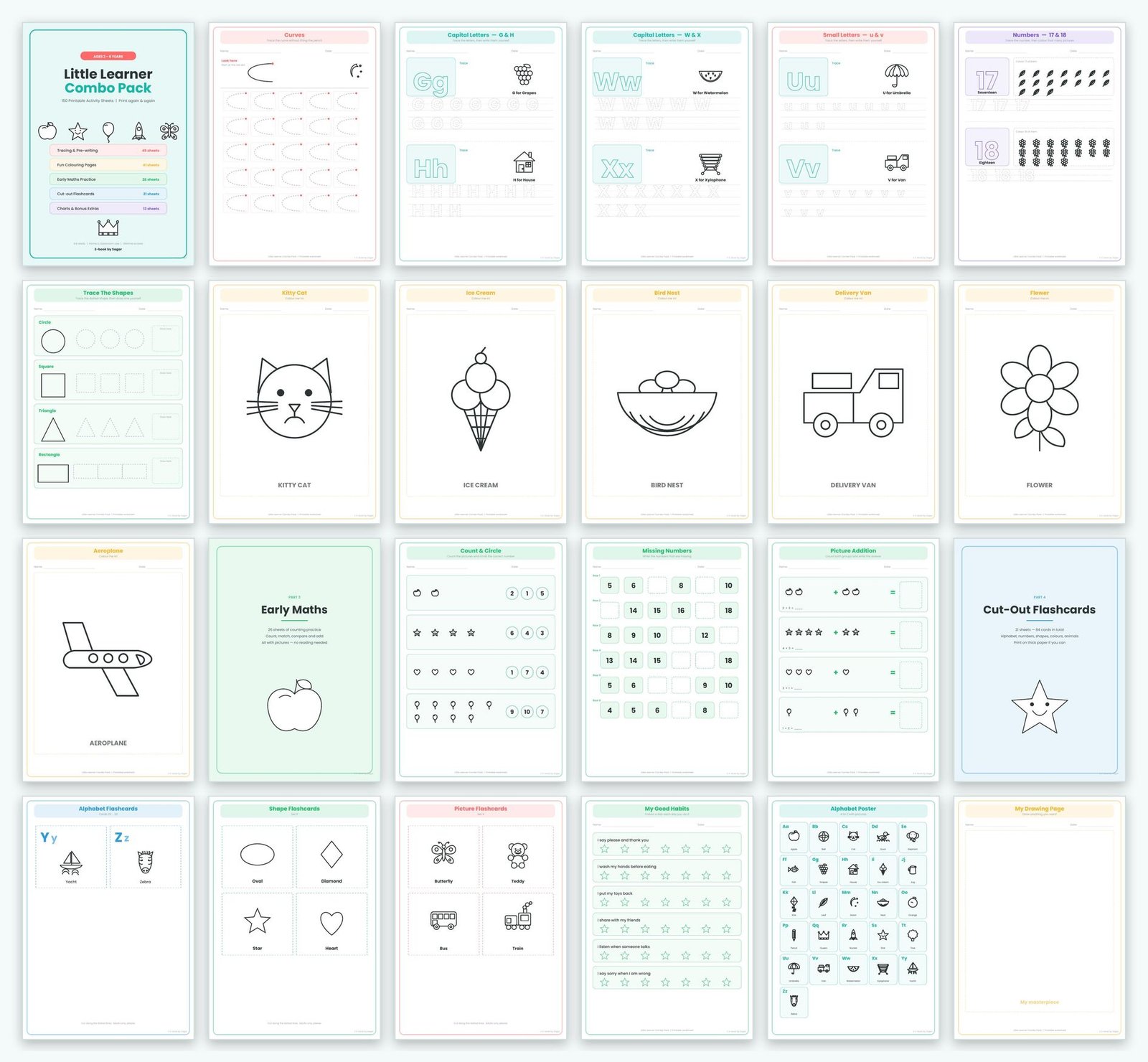
The Little Learner Combo Pack shows 24 real sample pages on the product page. 150 pages for ages 2 to 6: tracing, colouring, early maths, flashcards and charts. One payment of ₹49, print forever.
See sample pages & get the pack