
LKG worksheets for English and maths: syllabus and a weekly plan
LKG is the year when "playing" turns into "learning" for most children. Letters get sounds, numbers go past ten, and the class teacher starts sending home notes about writing practice. For many parents, it is also the year the question changes from "Should I do worksheets?" to "Which worksheets, and how many?"
This guide answers both. It covers the LKG syllabus for English and maths, the kinds of LKG worksheets that actually help, how much practice is right for a four year old, and a free plan builder that gives you a weekly schedule in seconds.
On this page
1. LKG syllabus: what your child learns this year
LKG (Lower Kindergarten, also called Junior KG, KG1 or PP2 in some places) is for children aged about four to five. Every school's syllabus is slightly different, but most CBSE, ICSE and state board pre-primary schools cover something close to this:
| Subject | Start of LKG | End of LKG |
|---|---|---|
| English | Recognises most capital letters | Knows capital and small letters, most letter sounds, writes letters with tracing support |
| Maths | Counts to 10 | Counts and writes 1–20 (some schools to 50), before/after, more/less |
| Concepts | Basic colours and shapes | Patterns, sorting, big/small, tall/short, heavy/light |
| EVS | Fruits, animals | Family, body parts, seasons, transport, community helpers |
| Writing | Pre-writing strokes | Traces small letters and numbers; begins copying from a model |
The two biggest jumps in LKG are small letters (a–z) and letter sounds. These are what most LKG English worksheets focus on, and they are where home practice makes the most difference.
2. LKG English worksheets
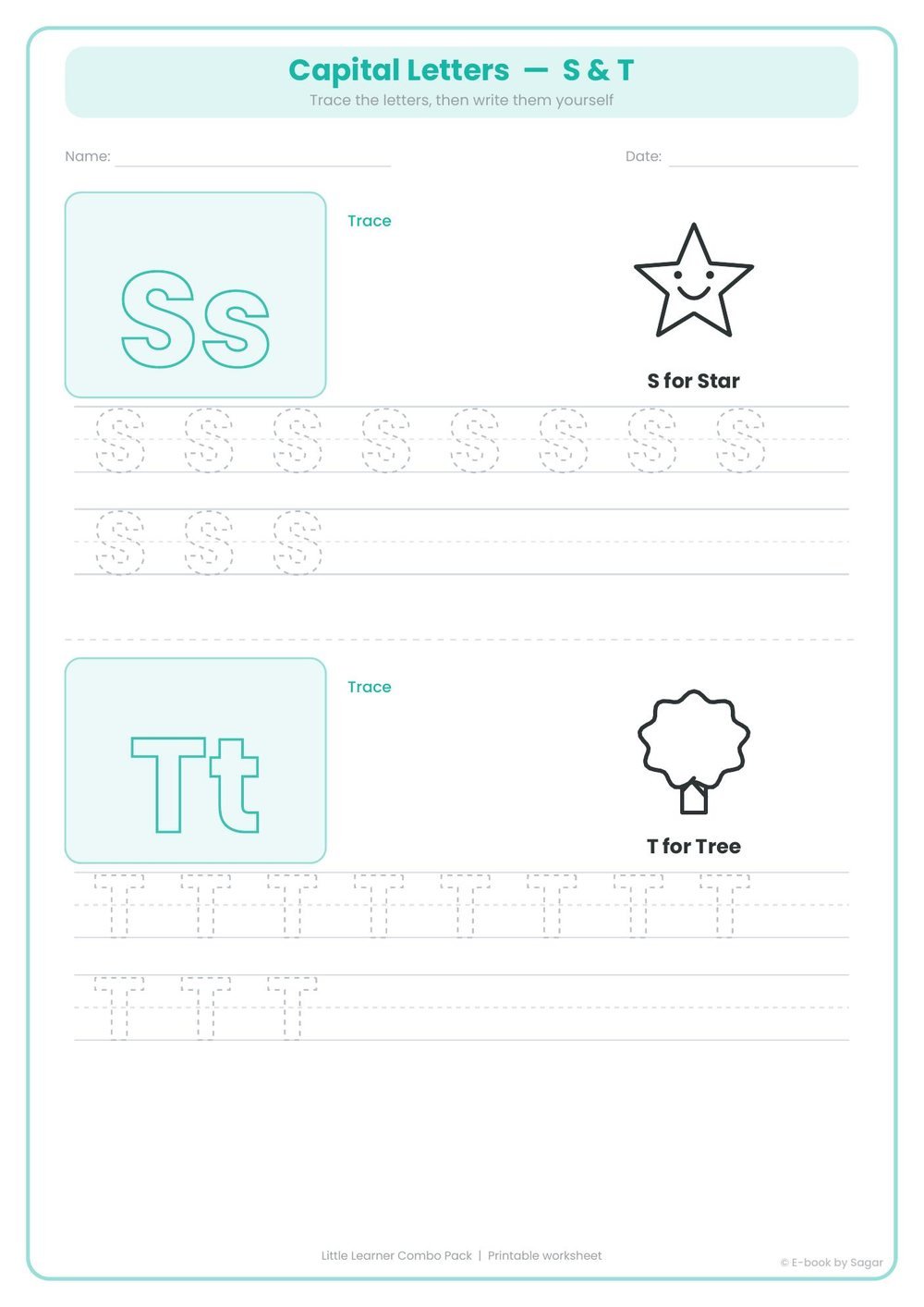
LKG English worksheets should move from recognising letters to linking them with sounds and, by the end of the year, to reading simple three-letter words. Useful types, in order:
- Capital letter revision: tracing A–Z with pictures, to make sure nursery learning is secure.
- Small letter tracing a–z: the main writing task of LKG. Each sheet should show where the pencil starts and which way it moves.
- Capital and small matching: draw a line from A to a, B to b. Builds the link between the two forms.
- Beginning sounds: "Circle the pictures that start with m." This is where phonics begins.
- Missing letters: A, B, __, D. Strengthens letter order.
- Picture vocabulary: name the picture, colour it, trace the first letter.
- CVC words (late LKG): simple words like cat, sun and pen to blend and read.
If your child's school uses phonics, keep home practice in step with it. Our guide on how to teach phonics at home explains the sound order most schools follow, and has a word builder you can play with together.
3. LKG maths worksheets
LKG maths is all about number sense: understanding what numbers mean, not just writing them. The best LKG maths worksheets always have pictures, so a child can count real things.
- Count and write: count the apples, write the number.
- Number tracing 1–20: with arrows showing the direction of each stroke.
- Match the number to the group: draw a line from 4 to the group of four ducks.
- Before, after and between: what comes after 6? What comes between 8 and 10?
- More and fewer: which basket has more mangoes?
- Patterns: circle, square, circle, square, what comes next?
- Shapes: trace, colour and count shapes in a picture.
Pair worksheets with real objects. If a sheet asks for seven, count out seven spoons first. Our guide to teaching numbers and counting has a step-by-step method and a counting game.
4. EVS and general awareness
EVS (environmental studies) in LKG is mostly talking and recognising rather than writing. Picture-based worksheets work best: colour the fruits, circle the animals that live in water, match the helper to their tool. Better still, connect it to real life. Name vegetables at the sabzi market, spot vehicles on the road, talk about the weather each morning. Colouring pages of animals, fruits and vehicles double as EVS practice.
5. Build your weekly LKG plan
Choose how many days a week you can practise and how long each session can be. The planner builds a balanced week of English, maths and fun, using the worksheet types above.
My child's LKG worksheet week
Each session ends with a two-minute flashcard game. Swap any day for outdoor play when needed; consistency over the month matters more than any single day.
6. How to make worksheet time work
- Keep it short. Ten to fifteen minutes is plenty for a four year old. Two good sheets beat six rushed ones.
- Use a thick pencil. Triangular or chunky pencils help small hands hold a correct grip. If the grip still needs work, see how to teach a child to hold a pencil.
- Say it while writing. "Small a: round, and up, and down." Saying the movement aloud helps children remember it.
- Check direction, not neatness. Starting a letter at the top and moving the right way matters more than a perfect shape.
- Mix up the format. Tracing on Monday, matching on Tuesday, a flashcard game on Wednesday. Variety keeps a four year old interested.
- Do not repeat homework. If the school already sends worksheets, use home time for the activities school does not cover, such as colouring, games and reading together.
- Use a reward chart. A sticker for each finished session, and a small treat for a full week, works wonders at this age.
7. Common LKG writing problems and simple fixes
Almost every LKG child hits a few bumps with writing. Most are normal stages, and a small change at home usually fixes them.
| Problem | Why it happens | What helps |
|---|---|---|
| Letters written from the bottom up | No one has shown the start point | Put a green dot where each letter starts; say "start at the top" every time |
| b and d, p and q mixed up | They are the same shape turned around | Normal until about seven; teach b with the "bed" trick and practise them on different days |
| Pressing very hard, paper tears | Gripping too tightly, weak hand muscles | Dough, clothes pegs and tongs games; a softer, thicker pencil |
| Very faint, shaky lines | Not enough hand strength yet | More colouring with crayons, and drawing on a wall or slanted board |
| Gets tired after a few letters | Hand and sitting stamina still developing | Shorter sessions, feet flat on the floor, table at elbow height |
| Refuses to write at all | Too much correction or too-hard pages | Go back to an easier page your child can finish proudly, and praise effort |
If a problem continues for months despite regular practice, mention it to the class teacher. Teachers see many children and can tell you whether it is part of normal development or worth a closer look.
8. Signs your child is ready for UKG work
Towards the end of LKG, look for these signs that your child is ready to move on to harder pages:
- Recognises all capital and most small letters, and knows most letter sounds.
- Traces letters and numbers starting at the right point, without help.
- Counts 20 objects correctly and recognises numerals to 20.
- Can blend a few three-letter words like cat and sun.
- Sits with a worksheet for ten minutes without getting upset.
When most of these are in place, move on to the next stage. Our guide to UKG worksheets covers what comes next and how to prepare for Class 1.
9. Questions parents ask
What is taught in LKG?
LKG covers capital and small letters, letter sounds, numbers 1 to 20 (sometimes 50), before and after, more and less, shapes, patterns, and EVS topics like family, body parts and transport.
How many worksheets should an LKG child do?
About four to five worksheets a week, ten to fifteen minutes a day, is a comfortable amount of home practice for a four year old.
Should LKG children write small letters?
Yes. Tracing small letters a to z is the main writing task of LKG. Children trace with support first and begin copying letters from a model towards the end of the year.
What maths worksheets are good for LKG?
Count and write, number tracing 1 to 20, matching numbers to groups, before and after, more and fewer, and simple patterns. Pictures matter more than written sums at this age.
What is the difference between LKG and UKG worksheets?
LKG focuses on letters, sounds and numbers to 20 with tracing support. UKG moves to writing without dots, reading simple words, numbers to 50 or 100 and picture addition.
150 LKG-ready worksheets, one payment
Small and capital letter tracing, numbers 1–20, count and write, missing numbers, more and fewer, colouring, flashcards and reward charts. One PDF, print as often as you like, for ₹49.
Get the worksheets pack — ₹49