
UKG worksheets: English, maths and getting ready for Class 1
UKG is the last year before "big school". In a few months your child will move to Class 1, where they will be expected to write without dots, read simple words and do small sums. That is why UKG is the year many parents start looking seriously for UKG worksheets — and also the year when the wrong kind of practice can make a child dread the pencil.
This guide explains the UKG syllabus for English and maths, which worksheets help most, how to build independent writing, and a Class 1 readiness checker that shows you exactly where to focus in the months that remain.
On this page
1. UKG syllabus at a glance
UKG (Upper Kindergarten, also called Senior KG, KG2 or Prep) is for children aged about five to six. Schools differ, but the goals by the end of UKG are broadly similar across boards:
| Area | By the end of UKG, most children can… |
|---|---|
| Reading | Read three-letter words, a set of common sight words and very short sentences |
| Writing | Write capital and small letters without dots, write their name, copy short words |
| Numbers | Count, read and write numbers to 50 (often to 100), before/after/between |
| Maths | Add and take away within 10 using pictures or objects, compare numbers, simple patterns |
| Concepts | Days of the week, shapes, time words (morning, night), money basics |
| Habits | Sit for 15–20 minutes, follow two-step instructions, manage their bag and tiffin |
The biggest shift is from tracing to writing alone, and from knowing letter sounds to reading words. Most UKG worksheets should be pushing gently in those two directions.
2. UKG English worksheets
Good UKG English worksheets build reading and writing together. Useful types:
- Letter writing without dots: a model letter, then empty lines to write it alone.
- CVC words: read the word, match it to the picture, or fill in the missing middle letter (c_t).
- Word families: -at, -en, -ig, -op, -un. Change the first letter to make a new word.
- Sight words: the, is, a, I, to, my, we, he, she, was. Trace, find and read in a sentence.
- Picture sentences: "This is a ___." Look at the picture and complete the sentence.
- Rhyming words: match cat to hat, sun to bun.
- Copy writing: copy a short line such as "I can run." onto ruled lines.
For the method behind reading words, see our guide on how to teach phonics, which includes an interactive CVC word builder.
3. UKG maths worksheets
UKG maths moves from counting to thinking with numbers. Pictures still matter: a child who can see three apples and two apples understands 3 + 2 far better than one staring at symbols.
- Missing numbers: 14, 15, __, 17. Builds number order to 50 and beyond.
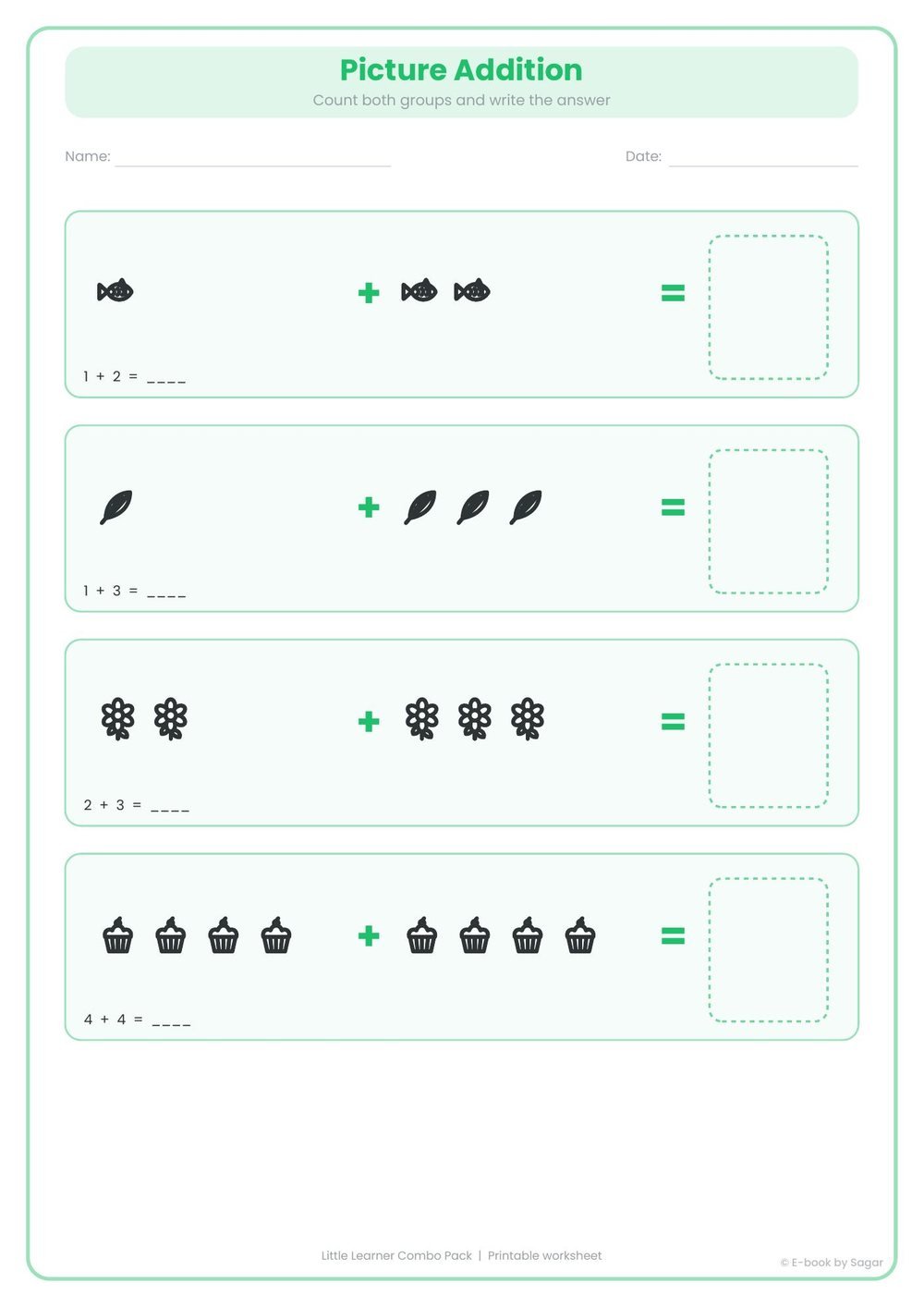
- Picture addition: count two groups and write the total.
- Picture subtraction: five balloons, two fly away, how many are left?
- Before, after and between for numbers to 50.
- Compare numbers: which is bigger, 18 or 13? Circle the smaller number.
- Number names: one to ten in words, matched to numerals.
- Shapes and patterns: continue the pattern, count the triangles.
4. From tracing to independent writing
The step from tracing dotted letters to writing on a blank line is harder than it looks. Children who are pushed straight onto blank pages often write letters from the bottom, mix up b and d, or give up. A gradual bridge works much better:
- Full tracingDotted letters all the way through. Focus on the start point and direction.
- Fading dotsOnly the first stroke is dotted; the child completes the rest from memory.
- Copy from a modelA complete letter or word on the left, empty space on the right.
- Write from memoryYou say a letter or word; your child writes it alone, then checks against a chart.
Four stages from tracing to independent writing
Spend a week or two at each stage, and go back a step whenever letters start to fall apart. Blank practice sheets with four-line ruling (like Class 1 notebooks) are ideal for the last two stages. If pencil grip is still a problem, fix it first with our guide on how to hold a pencil and the hand exercises in fine motor skills activities.
5. Class 1 readiness checker
Tick what your child can do comfortably today. You will see a score for each area and where to focus next.
Is my child ready for Class 1?
Do not worry if your child scores low in one area with a few months to go. Children often make sudden jumps in UKG, especially in reading. Steady, short practice closes most gaps by the end of the year.
6. A daily UKG routine that works
Twenty minutes a day is plenty for a five year old. Here is one way to use it:
| Minutes | Activity |
|---|---|
| 0–3 | Warm-up: flashcard game with sight words or numbers |
| 3–10 | One writing worksheet (letters or words, at the right stage) |
| 10–16 | One maths worksheet (missing numbers, picture addition) |
| 16–20 | Read a short book together; your child reads the words they can |
Put a sticker on a reward chart after each session. At this age, seeing a row of stars fill up is a powerful motivator, and it builds the habit of daily practice that Class 1 will need.
7. Mistakes parents make in UKG
- Too many pages. Ten worksheets in a sitting creates a child who hates worksheets. Two well-chosen pages are enough.
- Jumping straight to blank lines. Skipping the bridge from tracing leads to poor letter formation that is hard to fix later.
- Teaching sums before understanding. 4 + 3 on paper should come after many rounds of four spoons and three spoons.
- Comparing with other children. Some children read early, some click in Class 1. Both are normal.
- Dropping play. Five year olds still learn most through play. Keep the dough, blocks, outdoor games and colouring going.
- Ignoring screen time. Long hours on a phone make the calm focus of worksheet time much harder. Our guide on keeping kids busy without a mobile has screen-free ideas that fit around school.
8. Using the summer before Class 1
The long break between UKG and Class 1 is a great chance to consolidate — and also a time when skills can slip if nothing happens for two months. A light routine keeps your child ready without turning the holiday into school:
- Three or four short sessions a week rather than daily, so there is plenty of time for play and travel.
- Revise rather than race ahead. Letter formation, reading CVC words and numbers to 50 matter more than starting Class 1 work early.
- Read every day. Ten minutes of reading together does more for Class 1 than any worksheet.
- Practise independence: opening the tiffin, packing the bag, tying shoelaces or using velcro, going to the toilet alone.
- Shift the sleep routine towards school timings in the last two weeks of the holiday.
Children who return in April with steady writing and a reading habit settle into Class 1 far more confidently.
9. Questions parents ask
What should a child know at the end of UKG?
Most children can read three-letter words and some sight words, write letters without dots, write their name, count and write numbers to 50 or more, and add small numbers using pictures.
Which worksheets are best for UKG?
Letter writing without dots, CVC words, sight words, picture sentences, missing numbers, picture addition and subtraction, and comparing numbers.
How long should a UKG child study at home?
Around twenty minutes a day is enough: a short flashcard warm-up, one writing sheet, one maths sheet and a few minutes of reading together.
How do I move my child from tracing to writing alone?
Go in stages: full tracing, then fading dots, then copying from a model, then writing from memory. Spend a week or two on each stage and step back if letters fall apart.
Is my child ready for Class 1?
Signs of readiness include knowing most letter sounds, reading simple words, writing their name and small letters, counting to 20 and sitting with a task for 15 to 20 minutes.
Get ready for Class 1, 20 minutes a day
The Little Learner Combo Pack has 150 printable worksheets for ages 2 to 6: letter and number tracing, missing numbers, picture addition, blank practice sheets, flashcards, and routine and reward charts. One PDF for ₹49.
Get the worksheets pack — ₹49