
Kids age calculator: your child's exact age in years, months and days
How old is your child, exactly? It sounds like a simple question until a school form asks for age "in years and months as on 31 March", the paediatrician talks about "22 months", or you want to know how many days until the next birthday. This free kids age calculator gives you your child's exact age in years, months and days, plus total months, weeks and days, the next birthday countdown, the half-birthday, fun "day milestones", and corrected age for babies born early.
Kids age calculator
Enter your child's date of birth. Leave "Age on" as today, or pick any date (for example, a school's cut-off date).
On this page
- How to use the age calculator
- How the age is calculated
- Why exact age matters for parents
- Why doctors count age in months
- Corrected age for premature babies
- What to expect at each age, 2 to 6
- Age-appropriate learning at home
- Half-birthdays and day milestones
- Learning at every half-year, 2 to 6
- Teaching children about age and birthdays
- Questions parents ask
1. How to use the age calculator
- Enter the date of birth. Tap the date box and choose the day, month and year. On most phones a calendar opens automatically.
- Choose the "Age on" date. It is set to today. Change it if you need the age on another date, such as a school's cut-off date (often 31 March in India), the first day of a new session, or a future birthday party.
- Tell us if your child was born early (optional). If your baby arrived several weeks before the due date, choose roughly how early. The calculator will show the corrected age as well.
- Tap "Calculate age". You will see the exact age, total months, weeks and days, the next birthday countdown, the half-birthday date and upcoming day milestones.
Nothing you type is sent anywhere. The calculation happens entirely on your phone or computer, so you can use it freely for any date.
2. How the age is calculated
Calculating age by hand is surprisingly fiddly, because months have different lengths. This calculator follows the method used on school and medical forms:
- Years: count the full years between the birth date and the chosen date.
- Months: count the full months after the last birthday.
- Days: count the remaining days. If the day of the month has not yet been reached, the calculator "borrows" the number of days in the previous month, just as you would when subtracting dates on paper.
A worked example
A child born on 20 August 2022, with age calculated on 31 March 2027:
- From 20 August 2022 to 20 August 2026 is 4 full years.
- From 20 August 2026 to 20 March 2027 is 7 full months.
- From 20 March to 31 March is 11 days.
So the child is 4 years, 7 months and 11 days old on 31 March 2027. For a school using the common 31 March cut-off, that child fits LKG for the 2027-28 session. Leap years are handled automatically: a child born on 29 February has their birthday counted on 28 February in non-leap years.
| Unit | How it is counted |
|---|---|
| Total months | Years × 12 + remaining months (days are not rounded up) |
| Weeks | Total days ÷ 7, with the leftover days shown separately |
| Days | Exact calendar days between the two dates, including leap days |
| Hours | Days × 24, as an approximate fun figure |
3. Why exact age matters for parents
"She's four" is usually enough in conversation. But there are many moments in the early years when the exact age in years, months or even days makes a real difference:
- School admission. Schools decide the class by age on a specific cut-off date. A child who is 2 years 11 months on that date may have to wait a whole year for nursery. See our school admission age calculator and the guide to nursery admission 2027-28.
- Doctor visits and growth charts. Growth charts plot height and weight against age in months. Being off by a few months can make a child look taller or shorter than they really are for their age.
- Vaccination schedules. Many vaccines are due at specific ages in weeks or months. Knowing the exact age helps you keep track of what is due next, alongside your child's vaccination card.
- Developmental milestones. Milestones are usually described by age ranges in months, such as "by 18 months" or "by 3 years". Exact age helps you compare fairly.
- Choosing learning activities. A 2 year 1 month old and a 2 year 11 month old are at very different stages. The right worksheets for each age depend on more than just the year.
- Toys and safety labels. Labels such as "not suitable for children under 36 months" are about real choking risks, so the months matter.
- Travel tickets and forms. Airlines, railways and passport forms have their own age rules for infants and children, often based on age on the date of travel.
4. Why doctors count age in months
Ask a paediatrician how old a toddler is and you will often hear "26 months" rather than "2 years". There is a good reason for this. In the first few years, children change so quickly that a single year covers huge differences in growth and development. A child of 24 months and a child of 35 months are both "two", but one may be saying two-word phrases while the other speaks in full sentences.
Most doctors and child development charts use months up to about 24 or 36 months, then switch to years and months. That is why the calculator shows total months prominently. If a form asks for age in months, use that number.
5. Corrected age for premature babies
Babies born before 37 weeks of pregnancy are called premature (or preterm). A baby born 8 weeks early has, in a sense, had 8 fewer weeks of development before birth. That is why doctors use corrected age (also called adjusted age) when checking a premature baby's growth and milestones.
Corrected age = actual age − number of weeks born early.
For example, a baby born 8 weeks early who is now 6 months old has a corrected age of about 4 months. It is fairer to expect 4-month milestones, such as holding the head steady and reaching for toys, than 6-month milestones such as sitting with support.
- When to use it: for milestones, growth charts and starting solid foods, as your doctor advises.
- When to stop: most premature babies catch up by around age 2, and many doctors stop correcting at that point. For very early babies, your doctor may continue a little longer.
- What not to use it for: vaccinations are usually given by actual age, not corrected age. Always follow your doctor's schedule.
Choose the "born early" option in the calculator to see your child's corrected age alongside their actual age.
6. What to expect at each age, 2 to 6
Every child develops at their own pace, and a few months either way is completely normal. This table shows typical skills that many children show around each age. It is a general guide, not a checklist to worry over.
| Age | Language | Hands and body | Learning and play |
|---|---|---|---|
| 2 years | Two-word phrases, 50 or more words | Runs, kicks a ball, scribbles, stacks a few blocks | Pretend play begins, points to pictures in books |
| 3 years | Short sentences, asks lots of questions | Pedals a tricycle, copies a circle, turns pages | Knows some colours, counts a few objects, plays alongside others |
| 4 years | Tells simple stories, uses "why" and "how" | Hops, copies a cross, cuts with scissors | Recognises many letters, counts to 10 and more, plays cooperatively |
| 5 years | Speaks clearly, uses longer sentences | Skips, copies a triangle, writes some letters | Knows letter sounds, counts objects to 20, follows rules in games |
| 6 years | Explains ideas, enjoys jokes and riddles | Ties shoelaces (often), neater writing | Reads simple words, adds and takes away small numbers |
If you are worried that your child is well behind in several areas, or has lost skills they used to have, talk to your paediatrician. Early support makes a big difference. For hand skills specifically, our guide to fine motor skills includes a milestone checker.
7. Age-appropriate learning at home
Once you know your child's exact age, you can pick activities that fit. The aim is a "just right" challenge: hard enough to be interesting, easy enough to feel successful.
Around 2 years
Big movements and big crayons. Colouring pages with thick outlines, scribbling on large paper, play dough, stacking cups, picture books and songs. Sessions of 5 minutes are plenty.
Around 3 years
Pre-writing strokes such as standing and sleeping lines, curves and circles. Matching colours and shapes, counting real objects to 5, alphabet songs with letter cards. Our nursery worksheets guide has a four-week plan.
Around 4 years
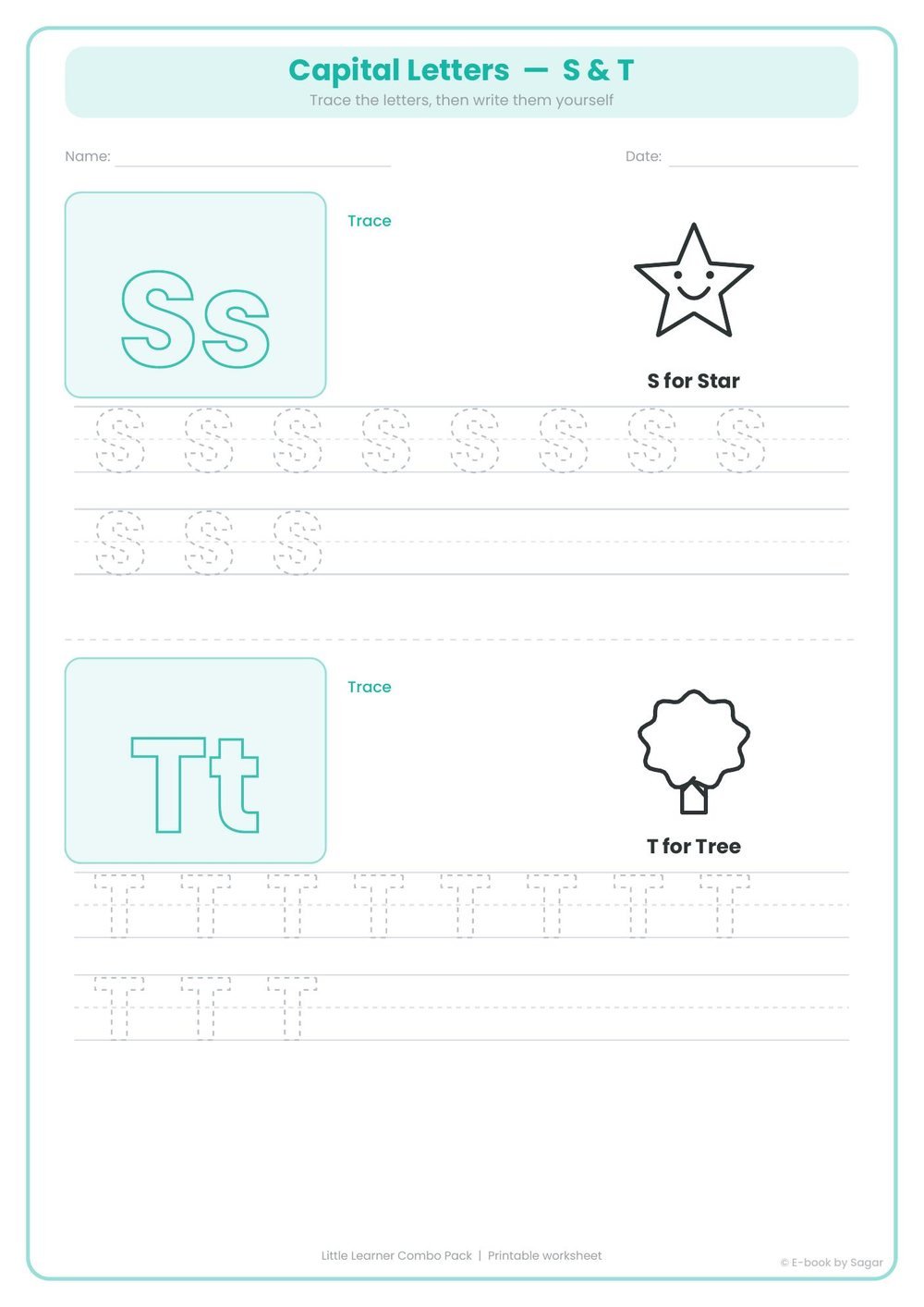
Capital letter tracing with a picture for each letter, counting to 10 and beyond, numbers 1 to 10, letter sounds, and simple patterns. See LKG worksheets or, in the US, pre-K worksheets.
Around 5 to 6 years
Small letters, writing without dots, reading three-letter words, numbers to 20 and beyond, and picture addition. The UKG worksheets guide includes a Class 1 readiness checker.
At every age, the most powerful learning activity is still the simplest: reading aloud together every day.
8. Half-birthdays and day milestones
Children love having something to look forward to, and these small celebrations are a fun way to mark time between birthdays:
- Half-birthday: six months after the birthday. Especially popular for children whose birthday falls during school holidays, so classmates can celebrate with them.
- 1,000 days old: a child reaches 1,000 days at about 2 years and 9 months. Some families mark it with a special photo or a small cake.
- 2,000 days old: at about 5 years and 6 months, often just as they get ready for Class 1 or kindergarten.
- Counting down: the "days to go" figure is a lovely counting activity in itself. Make a paper chain with one link per day and remove one every morning.
The calculator shows the next two day milestones automatically, along with the half-birthday date.
Common age-calculation mistakes
- Subtracting only the years. 2027 minus 2023 is 4, but a child born in December 2023 is only 3 in March 2027.
- Counting every month as 30 days. This gives the wrong number of days, especially across February.
- Using today's date for a school form that asks for age on a specific cut-off date. Always change the "Age on" date to match the form.
- Forgetting leap years when counting days. The calculator includes every 29 February automatically.
9. Learning at every half-year, 2 to 6
Six months is a long time in early childhood. Planning learning in half-year steps, rather than whole years, helps you keep activities "just right". Use your child's exact age from the calculator to find their row:
| Age | Focus at home | Good worksheet types |
|---|---|---|
| 2 to 2½ | Naming objects, scribbling, simple puzzles, songs | Big colouring pages, finger painting |
| 2½ to 3 | Colours, big and small, holding a crayon with fingers | Colouring, standing and sleeping lines |
| 3 to 3½ | Shapes, counting to 5, first letters (their name) | Curves and circles, shape tracing, matching |
| 3½ to 4 | Capital letters, counting to 10, simple patterns | Capital letter tracing, count and colour |
| 4 to 4½ | Letter sounds, numbers 1–10, more and fewer | Number tracing, beginning sounds, comparison |
| 4½ to 5 | Small letters, numbers to 20, before and after | Small letter tracing, missing numbers |
| 5 to 5½ | Blending three-letter words, writing their name | CVC words, copying words, picture addition |
| 5½ to 6 | Writing without dots, simple sums, reading short sentences | Blank practice sheets, addition and subtraction |
Treat the table as a menu, not a timetable. If your child is younger in one area and older in another, follow their lead. A short daily session of 5 to 15 minutes, matched to the right row, is far more effective than long sessions that are too hard or too easy.
10. Teaching children about age and birthdays
Young children are fascinated by age: who is older, how many sleeps until a birthday, and when they will be "big". These moments are perfect for early maths:
- Count the candles. Counting candles, fingers ("show me how old you are") and years is a child's first experience of numbers that describe themselves.
- Make a birthday countdown. Use the calculator's "days to go" number for a paper chain or a calendar to cross off each morning. It teaches counting down and the days of the week.
- Older and younger. Line up family photos and order them from youngest to oldest. Who was born first?
- Then and now. Compare baby photos with today: "Then you crawled, now you run." It builds language about time: before, after, then, now.
- Measure and record. Mark your child's height on a wall chart on each birthday. Our child height predictor explains how children grow each year.
11. Questions parents ask
How do I calculate my child's exact age?
Count the full years since birth, then the full months since the last birthday, then the remaining days. If the day of the month has not been reached yet, borrow the days of the previous month. The calculator above does this automatically for any date.
How do I calculate age in months?
Multiply the full years by 12 and add the remaining full months. For example, a child who is 2 years and 5 months old is 29 months old. Days are not rounded up.
What is corrected age for a premature baby?
Corrected age is the actual age minus the number of weeks the baby was born early. A baby born 8 weeks early who is 6 months old has a corrected age of about 4 months. Doctors use it for milestones and growth, usually until about age 2.
Can I calculate my child's age on a future date?
Yes. Change the Age on date to any date, such as a school cut-off date or a future birthday, and the calculator shows the exact age on that day.
When is my child 1,000 days old?
A child is 1,000 days old at about 2 years and 9 months. The calculator shows the exact date of the next day milestones, such as 1,000 and 2,000 days.
Is my data saved?
No. The calculation happens entirely in your browser. Nothing you enter is stored or sent anywhere.