
Pre-K worksheets: what to practice at age 4, and where to start
Pre-K is the year before kindergarten, and for many families it is the first time worksheets come home in a backpack. It is also the year parents start searching for pre-K worksheets to practice at home — and quickly discover thousands of random pages, some far too hard for a four year old and most in no particular order.
This guide helps you choose well. It covers what children typically learn in pre-K, the worksheet types that genuinely help, a quick quiz to find the right starting level for your child, how to use worksheets without tears, and a weekly routine that fits around a busy family schedule.
On this page
1. What children learn in pre-K
Pre-K programs vary across states, districts and private preschools, but most cover similar ground for children aged about four to five:
| Area | Typical pre-K goals |
|---|---|
| Literacy | Recognize most uppercase and some lowercase letters, connect letters to sounds, hear rhymes, recognize their name |
| Writing | Hold a pencil with a developing grip, trace lines and shapes, attempt their name |
| Math | Count to 20, count objects to 10, recognize numerals, compare more and less, name shapes |
| Thinking skills | Sort, match, find patterns, spot what is different |
| Social-emotional | Take turns, follow routines, manage frustration, work in a group |
Worksheets support the first four areas. The fifth comes from play, routines and time with other children, so worksheets should always be one part of a bigger day, never the whole of it.
2. 8 types of pre-K worksheets that help
Good pre-K worksheets have big pictures, clear starting dots and almost no written instructions, so a child who cannot read yet still understands the task. These eight types cover most of what pre-K needs, roughly from easiest to hardest:
1. Pre-writing lines
Vertical, horizontal and diagonal lines, curves, circles and zigzags. Every letter is built from these strokes, so they come first.
2. Coloring pages
Thick-outlined pictures build hand strength and control. Do not expect a four year old to stay neatly inside the lines; aiming for the lines is the point.
3. Shape tracing
Circle, square, triangle and rectangle, traced and then colored. Shapes are both a math skill and writing practice.
4. Uppercase letter tracing
Large dotted letters with a picture (A for apple). Uppercase letters come first because they are mostly straight lines.
5. Lowercase letter tracing
Once uppercase letters are comfortable, introduce lowercase. Most printed words use lowercase, so it matters for reading.
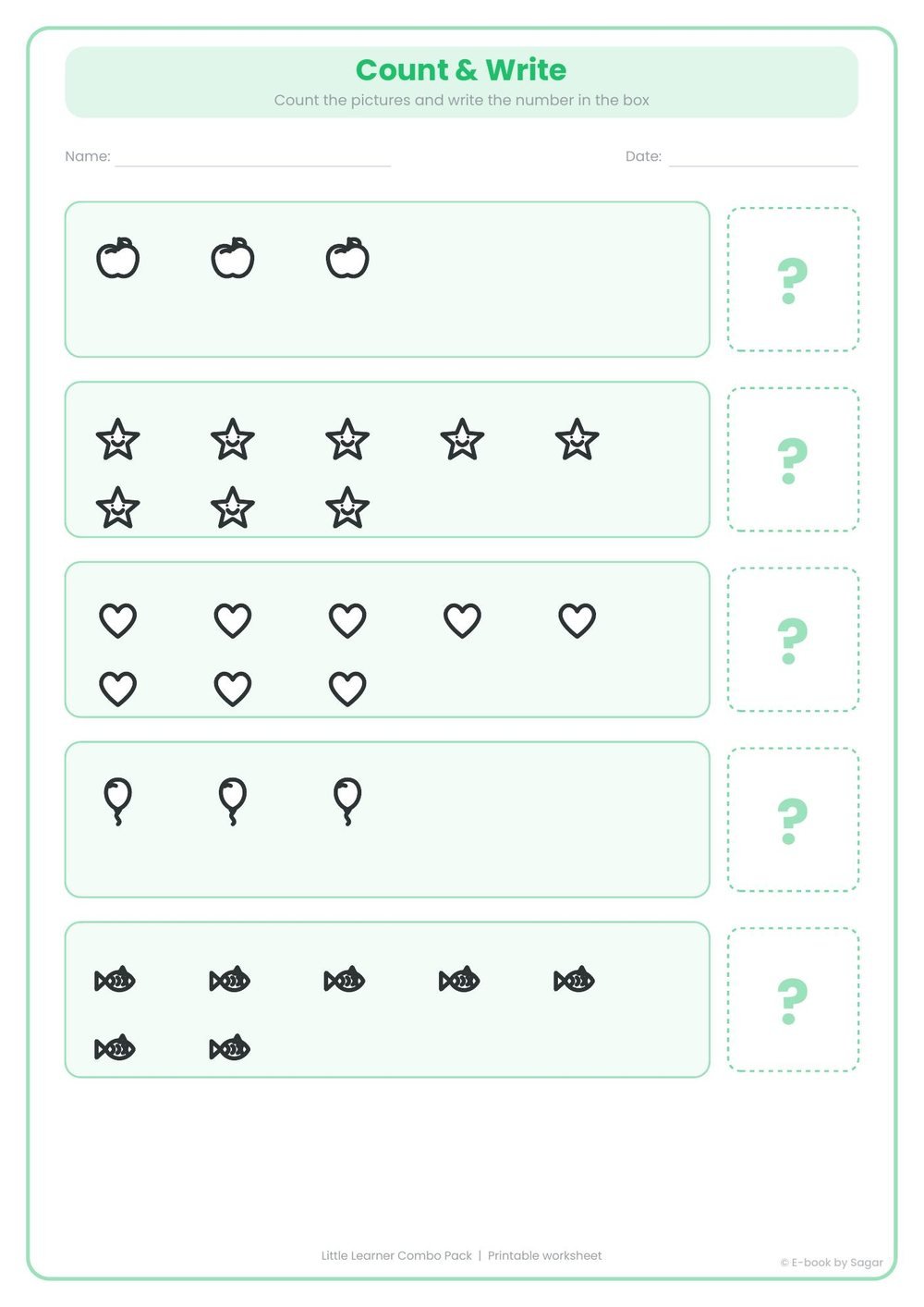
6. Count and write
Count the pictures and trace or circle the number. This connects quantity to numeral, the heart of early math.
7. Matching and comparing
Match the number to the group, circle the bigger animal, which basket has more apples? No writing needed.
8. Flashcards
Not worksheets exactly, but just as useful: letter, number, color and shape cards for two-minute review games.
3. Quiz: where should my child start?
Answer four quick questions and we will suggest the right level of worksheets to start with.
Find your child's starting level
4. How to use worksheets with a 4 year old
- Keep sessions short. Ten to fifteen minutes is right for most four year olds. One or two pages is plenty.
- Same time, same place. A small table and a regular time (after breakfast, or after preschool pick-up) turn worksheets into a habit rather than a negotiation.
- Talk before writing. "What's this? A ball! What sound does ball start with? Let's trace the B."
- Show the starting point. Most letters and numbers start at the top. A small green dot on the starting point helps.
- Use chunky tools. Triangular crayons or thick pencils make a good grip easier. See how to teach a child to hold a pencil.
- Praise effort. "You went all the way around the circle!" beats "That's messy."
- Stop on a high note. End while your child still wants more, and they will come back tomorrow.
- Use a reward chart. A sticker per session and a small treat for a full week works wonders at this age.
5. A simple pre-K week at home
Here is one way to spread practice through a week, at about 15 minutes a day:
| Day | Worksheet | Hands-on extra |
|---|---|---|
| Monday | Uppercase letter tracing (new letter) | Find 3 things that start with that sound |
| Tuesday | Count and write 1–10 | Count snacks, stairs or toy cars |
| Wednesday | Uppercase letter tracing (second letter) | Make the letter with play dough |
| Thursday | Shapes or matching sheet | Shape hunt around the house |
| Friday | Coloring page of their choice | Flashcard treasure hunt |
| Weekend | No worksheets | Library visit, park, cooking together |
That adds up to about five pages a week, or twenty a month. Over a school year, it is well over 150 pages, which is why many families prefer a printable pack they can print from again and again, rather than buying a new workbook every few weeks. Our honest comparison of activity books and printables breaks down the costs.
6. What worksheets cannot do
Worksheets are a great tool, but they are only one tool. A four year old also needs:
- Read-aloud time every day. It builds vocabulary and a love of books that no worksheet can.
- Hands-on math. Counting real objects, cooking, and board games with dice.
- Big movement. Climbing, running and playground time build the core strength that helps children sit and write.
- Pretend play. Store, doctor, kitchen — where language and social skills grow fastest.
- Fine motor play. Play dough, beads, scissors and building blocks. Our 30 fine motor activities are a good start.
Think of worksheets as the bridge between play and school: short, focused practice that turns what children learn through play into the specific skills kindergarten builds on. Our kindergarten readiness checklist shows how it all fits together.
7. Printing tips
- US Letter or A4: most printable PDFs print fine on US Letter paper; choose "Fit to page" in the print dialog if the margins look tight.
- Black and white is fine. Your child does the coloring.
- Print a week at a time and keep pages in a folder, so there is always something ready.
- Make it reusable. Slide favorite tracing pages into sheet protectors and use dry-erase markers.
- Print favorites twice. Repeating a page they are proud of builds confidence.
8. Signs your child is ready for harder pages
Moving on too early leads to frustration; staying too long leads to boredom. Watch for these signs that your child is ready for the next level of worksheets:
- They finish pages quickly and accurately, and start asking for "more" or "a hard one."
- Their lines are steady and they start letters and numbers at the right point without reminders.
- They recognize the letters or numbers on sight before tracing them, rather than discovering them on the page.
- They can sit with one page for ten minutes without getting upset.
And the signs to step back: crumpled pages, pressing so hard the paper tears, refusing to start, or tears. None of these mean your child is behind. They usually mean the page is one step too hard. Go back to something they can finish proudly, rebuild confidence for a week or two, then try again.
9. Questions parents ask
What should a pre-K child learn?
Most pre-K programs work on recognizing uppercase and some lowercase letters, early letter sounds, tracing lines and shapes, counting objects to 10, recognizing numerals, shapes, sorting and patterns, and social skills like taking turns.
Are worksheets good for pre-K?
In small amounts, yes. One or two pages a day, 10 to 15 minutes, supports letter, number and fine motor skills. Worksheets should be one part of a day that also includes reading, play and outdoor time.
What worksheets should a 4 year old start with?
Start with pre-writing lines, coloring and shape tracing, then uppercase letters and count-and-write to 10. Move on to lowercase letters and numbers to 20 when those feel easy.
Will A4 printables work on US Letter paper?
Yes. Choose Fit to page or Scale to fit in your print settings and A4 pages print neatly on US Letter paper with slightly smaller margins.
How many worksheets should a pre-K child do a week?
About five pages a week, one per weekday, is a comfortable amount of home practice for most four year olds.
150 pre-K and kindergarten-prep worksheets
Tracing, coloring, early math, flashcards and charts for ages 2 to 6, arranged from easiest to hardest. Instant PDF download that prints on US Letter. One payment, under US$1.
See sample pages & get the pack