
Homeschool preschool curriculum: a simple, low-cost plan that works

More families in the US are choosing to homeschool preschool, whether to save on high childcare costs, to keep a young child at home a little longer, or simply because they enjoy learning together. The first question is almost always the same: what curriculum should I use?
Here is the good news: you do not need an expensive boxed curriculum to homeschool a three or four year old. Preschool learning is mostly reading together, playing, talking, moving and a little focused practice. This guide gives you a simple, low-cost homeschool preschool plan: what to cover, how long each day should be, a 12-week theme plan, and an interactive schedule builder you can use tomorrow morning.
On this page
1. Does a preschooler need a curriculum?
Not in the formal sense. Preschool is not required in any US state, and the skills children build at three and four come mainly from rich everyday experiences. What a curriculum does give you is structure: a sense of what to do each day so learning does not get lost in laundry and errands.
The simplest structure that works is a combination of:
- a daily rhythm (the same few blocks in the same order),
- a weekly theme to give activities a focus, and
- a set of printable worksheets arranged from easy to hard, so you always know what comes next.
That combination costs a fraction of a boxed curriculum and is easy to adjust to your child's pace.
2. What to cover: the 6 areas
- Language and readingDaily read-alouds, rhymes, conversation, letter recognition and early letter sounds.
- Early mathCounting objects, numerals 1–10 (then 20), shapes, patterns, sorting, more and less.
- Fine motor and pre-writingColoring, play dough, scissors, beads, then tracing lines, letters and numbers.
- Gross motorRunning, climbing, balancing, throwing and catching — daily, outdoors whenever possible.
- Science and the worldNature walks, weather, animals, simple experiments, community helpers.
- Social-emotionalNaming feelings, taking turns, helping at home, time with other children.
Six areas a homeschool preschool day can touch, most of them through play
Social time deserves a special mention for homeschoolers. Library story times, park meetups, co-ops and classes give children practice in group settings, which matters a great deal for kindergarten readiness.
3. How long should homeschool preschool be?
Shorter than most parents expect. A focused "learning time" of 20 to 30 minutes for a three year old, and 30 to 45 minutes for a four year old, broken into small blocks, is plenty. The rest of the day — play, outdoor time, cooking, errands — is learning too, especially when you talk through it.
Signs you are doing too much: your child resists starting, tears appear regularly, or they cannot sit for more than a minute. Signs it is working: they ask for "school time," remember yesterday's activities, and bring up the theme in play.
My homeschool preschool day
4. A 12-week theme plan
Weekly themes make planning easy: pick books from the library on the theme, choose a related craft, and match the letter and number of the week. Here is a starter plan you can repeat or adapt:
| Week | Theme | Letter | Number | Hands-on idea |
|---|---|---|---|---|
| 1 | All about me | A | 1 | Trace your body on big paper |
| 2 | My family | B | 2 | Family photo book |
| 3 | Colors | C | 3 | Color sorting with toys |
| 4 | Fall and leaves | D | 4 | Leaf rubbings |
| 5 | Farm animals | E | 5 | Animal sounds game |
| 6 | Shapes | F | 6 | Shape hunt at home |
| 7 | Thanksgiving and gratitude | G | 7 | Thankful tree |
| 8 | Weather | H | 8 | Daily weather chart |
| 9 | Community helpers | I | 9 | Pretend post office |
| 10 | Winter | J | 10 | Ice melting experiment |
| 11 | Transportation | K | Review 1–10 | Cardboard box car |
| 12 | Healthy habits | L | Review 1–10 | Toothbrushing chart |
Continue with M to Z and numbers 11 to 20 over the following weeks. If you prefer, follow a phonics order instead of A to Z; our guide on teaching phonics at home explains why many teachers start with s, a, t, p, i, n. For Thanksgiving week ideas, see Thanksgiving activities for preschoolers.
5. Materials you actually need
Skip the expensive kits. A homeschool preschool runs well on:
- A library card. The most valuable resource you have. Borrow 10 to 15 books a week on your theme.
- Printable worksheets arranged from easy to hard: tracing, coloring, early math and flashcards.
- Art supplies: chunky crayons, washable markers, glue sticks, child-safe scissors, construction paper.
- Play dough (homemade is easy and cheap).
- Counting objects: buttons, blocks, dried beans (for children past the mouthing stage), toy cars.
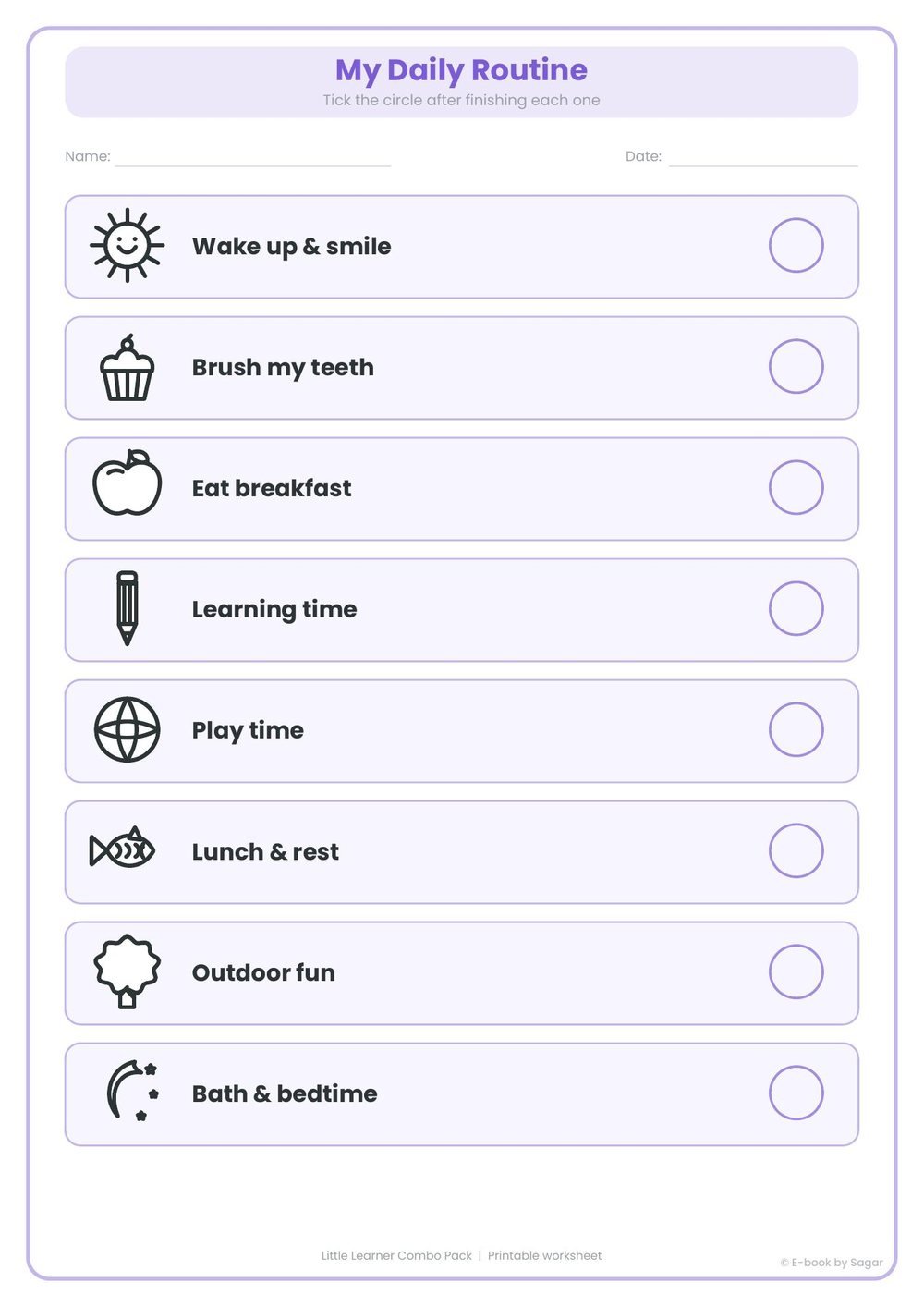
- A visual daily schedule and a reward chart. Young children feel secure when they can see what comes next.
- Outdoor space: a backyard, a park, or a sidewalk for chalk.
Comparing options? Our activity books vs printable worksheets guide includes a cost calculator.
6. Tips from homeschooling families
- Rhythm over schedule. Keep the same order of activities every day, but let the clock flex. Young children care about "what comes next," not "what time is it."
- Follow their interests. If your child is obsessed with dinosaurs, make it dinosaur week, whatever the plan says.
- Do the hard part first. Focused activities go best in the morning, after breakfast and before energy dips.
- Plan once a week. Fifteen minutes on Sunday to pick books, print pages and gather supplies saves daily stress.
- Keep it short. End before your child loses interest, and they will look forward to tomorrow.
- Count everyday life. Cooking, grocery shopping and walks are full of counting, colors, letters and science.
- Find your people. Local homeschool co-ops and library programs provide friends for your child and support for you.
7. A sample homeschool preschool week
Here is how one theme week ("Farm animals," letter E, number 5) might look for a four year old, around 30 to 40 minutes of focused time a day:
| Day | Focused learning | Hands-on and outdoors |
|---|---|---|
| Monday | Read two farm books; introduce letter E with a tracing page | Animal sounds game; farm toy sorting |
| Tuesday | Count and write to 5 worksheet; read aloud | Count animal toys into "barns" (boxes) |
| Wednesday | Letter E hunt in books; coloring page of a farm animal | Visit a farm, petting zoo or farmers market if possible |
| Thursday | Matching sheet: big and small animals; flashcards | Make play-dough animals |
| Friday | Review week's letter and number; child "reads" a favorite book to you | Draw the favorite animal; outdoor play |
Notice that only one or two items each day involve a worksheet. The rest is reading, talking, sorting, making and moving — which is exactly how preschoolers learn best. Keep the same structure every week and simply swap the theme, letter and number.
8. Questions parents ask
Do I need a curriculum to homeschool preschool?
No. A daily rhythm, a weekly theme, library books and a set of printable worksheets arranged from easy to hard cover what most three and four year olds need, at a fraction of the cost of a boxed curriculum.
How many hours a day is homeschool preschool?
Focused learning time of about 20 to 30 minutes for a three year old and 30 to 45 minutes for a four year old is plenty, broken into short blocks. Play and everyday life fill the rest of the day.
What should I teach in homeschool preschool?
Cover six areas: language and reading, early math, fine motor and pre-writing, gross motor play, science and the world around them, and social-emotional skills.
How do I make sure my homeschooled preschooler socializes?
Use library story times, park meetups, homeschool co-ops, classes and playdates so your child regularly practices taking turns and joining in with a group.
What is a good weekly theme plan for preschool?
Start with themes close to your child's life, such as all about me, family, colors, seasons, animals, shapes, holidays and community helpers, each paired with a letter and a number of the week.
Homeschool preschool printables for a whole year
The Little Learner Combo Pack has 150 printable pages for ages 2 to 6: tracing, coloring, early math, flashcards, a routine chart and a reward chart. Instant PDF, prints on US Letter. One payment, under US$1.
See sample pages & get the pack